Since this was posted10 days ago, the SAAS site has been fully updated for 2015-16.
However, there remains no official Scottish Government announcement – not even a written PQ – of the student support rates for next year in Scotland, which remain unchanged from 2014-15.
A written answer in the Scottish Parliament on 2 April (S4W-25214: see here) usefully provides an updated list of special advisers to Scottish government ministers. The question was asked by Bill Kidd MSP, a government backbencher, and therefore is probably what’s technically termed an “inspired” PQ, that is, one the government is using to place something formally on the record.
The answer lists 11 long-standing special advisers, plus two newly-appointed as of 1 April 2015. The new appointees are Jeanette Campbell for Social Justice and Kate Higgins for Education and Lifelong Learning.There does not seem to have been any other announcement about these appointments.
The education brief is clearly central to the Scottish Government’s current narrative, with major initiatives recently announced on widening access to higher education and closing the attainment gap in schools.
The SG website entry on Special Advisers has not yet been updated from February, so it can be seen that Kate Higgins assumes responsibilities in this area from Colin McAllister, who remains a special adviser but without the education brief.
Given there was some activity on Twitter last month about her possible appointment, it seems fairly likely this is the prominent SNP-supporting commentator and political blogger of the same name. Kate Higgins is a political campaigner, with a recent background in children’s charities (she has also been briefly profiled by the Guardian here). Jeanette Campbell appears likely to be the former director of public affairs at Citizens Advice Scotland and former Head of Research for the SNP parliamentary group.
Special advisers can play a critical, if largely unseen, role in government policy-making. Together with parliamentary aides (for Education and Lifelong Learning, George Adam MSP: for more on parliamentary aides in general, and their particular importance within the Holyrood committee system, see here) they provide ministers with additional, essential political backroom support. Special advisers are temporary civil service appointments and therefore subject to certain restrictions, including:
Special advisers must not take part in national political activities, which are:holding, in a party political organisation, office which impinges wholly or mainly on party politics in the field of Parliament, the Scottish Parliament, the National Assembly for Wales, the Northern Ireland Assembly or the European Parliament; speaking in public on matters of national political controversy; expressing views on such matters in letters to the Press, or in books, articles or leaflets; being announced publicly as a candidate or prospective candidate for Parliament, the Scottish Parliament, the National Assembly for Wales, the Northern Ireland Assembly or the European Parliament; and canvassing on behalf of a candidate for the institutions or on behalf of a political party.
Clues to Kate Higgins’ position on particular educational issues are limited. Her blog, Burdzeyeview, doesn’t have much education material on it (here are the couple of items tagged on that theme), but one from March 2012 discusses progress on the implementation of the Curriculum for Excellence and she has also supported free music tuition for children (which doesn’t come up among the articles tagged as education on the blog, so there may be more there on this topic). Her book, Generation Scot Y, contains some brief discussion of tuition fees and Scotland’s failure to close the attainment gap. Her author profile on the Herald site describes her as “passionate about social justice” and she has written on children’s rights and social justice, although this recent piece on foodbanks attracted some criticism from the director of the Trussel Trust.
Footnote
There was some criticism at the start of this year when the number of Special Advisers reportedly rose to 14. However, the numbers in the Herald article are different from those in the PQ answer, which suggests that only 11 advisers were in post after the change of First Minister: there are now 13.
This post noted that on 1 April there was still no information on the 2015-26 student support rates in Scotland.
Thank-you to someone who happened to be checking the SAAS website today and let me know that since mid-week the funding guide linked on the SAAS site has been updated for 2015-2016 – the alternating banner headline on the site now alerts visitors to the new guide being available: it is here. The relevant page on the SAAS site with the link is here.
The main pages are yet to be fully updated and still refer to 2014-15
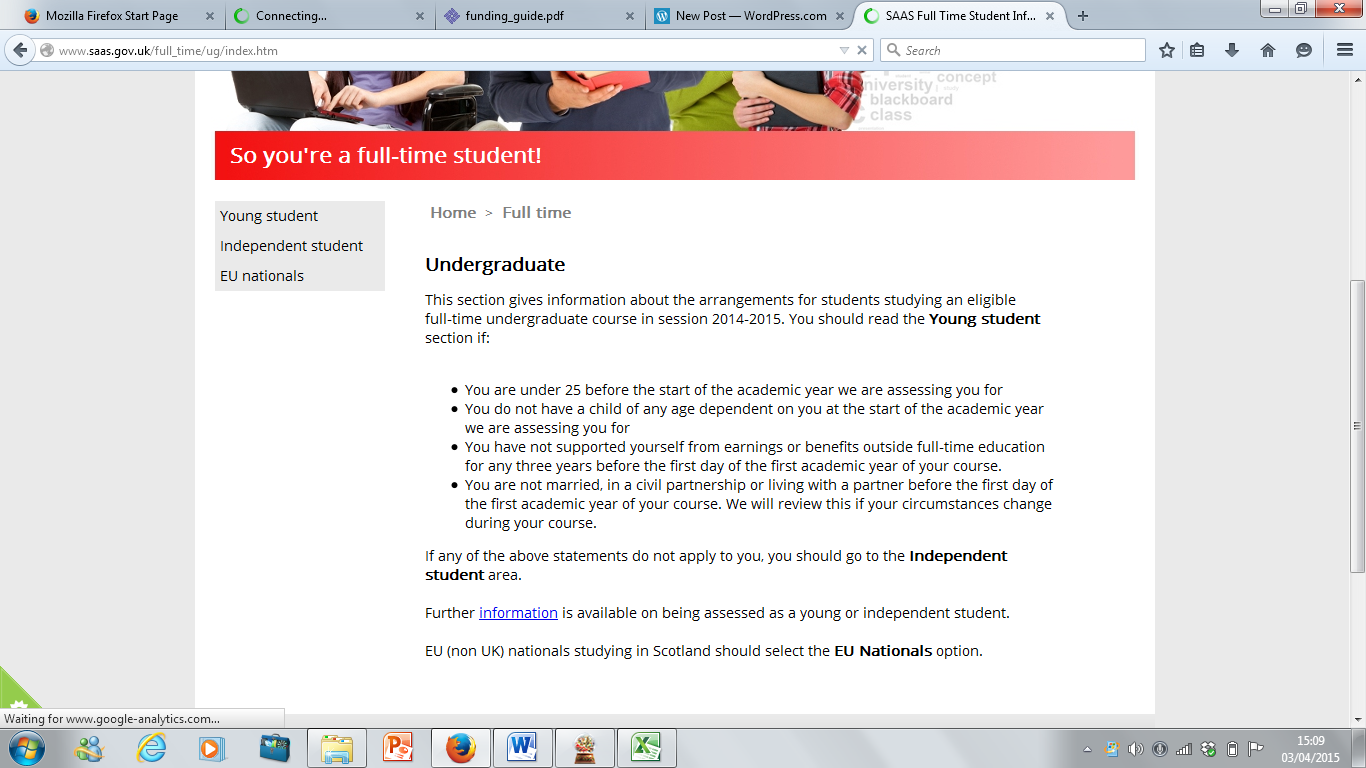
and there does not appear to be any announcement as yet on the government news pages.

Maybe something is planned for after the holiday weekend (today is Good Friday, so this may be a few days away).
The grant and loan rates remain at the same levels since 2014-15, in line with the prediction in this piece about the Scottish budget, from August 2013, that “freezing student grant levels … seems likely to be a strong contender for managing the pressure [on the budget]”. Grant rates are now unchanged since 2013-14.
In what appears to be a radical experiment in testing how far students really need advance information on their financial entitlements, the Scottish government has still to announce its student support rates for the coming academic year. These have traditionally been made available in the autumn.
According to the banner on the SAAS website as at today, applications for 2015-16 will open “in early April”. On the agency’s Facebook page, a message dated 30 March says mid-April.
Either way, students applying at that point will be doing so having had access to the relevant information for just a couple of weeks, at most. Indeed, almost as soon as the information is available, students are likely to be met with messages to get their funding application in early: that campaign started in late (or possibly mid-, it depends on your definitions) April last year.
By this time last year, in line with previous years, details of the rates for the year ahead had been available for five months, a printed guide had been circulation for a while and a video had been available for viewing with S5 and S6 pupils – who are now of course deep into exam preparation.
This year, the assumption seems to be that none of this advance information is necessary.
The laissez-faire attitude to public information on display here sits at odds with the insistence that policy on student finance affects student decision making, as argued recently by the First Minister:
our minimum income guarantee provides students from the poorest households with £7,500 of living-costs support every year. That support has helped to ensure that record numbers of 18-year-olds from the most disadvantaged areas are being accepted to university.
As Scottish Ministers have lately emphasised, Scotland has some way to go in widening access to HE. Research consistently shows that it is those from the poorest backgrounds who will tend to be most concerned about their finances. We will probably never be able to tell if there are already individuals who have drifted away from deciding to apply, because they couldn’t get information on what would be on offer for living costs. It is much more likely to be true however that there are numbers of people feeling stressed about the lack of information and that those people largely come from poorer backgrounds. If actions speak louder than words, then delaying this announcement shows very little regard for exactly the sort of students who are supposed to be at the heart of government policy.
Perhaps the word has gone out quietly round the system that nothing will be changing? That outcome would be the obvious inference from the budget figures (see here), but it’s no substitute for putting the information out there in a form that everyone can access – and subject to scrutiny. Indeed, if the government has known for a while that nothing is changing, but has not wanted to say so, it would be a striking (and unimpressive) case of putting presentational considerations ahead of the practical interests of students and their families.
The government must also be assuming that a delay in putting out the information will not delay students in submitting applications. In recent years, SAAS has worked hard to avoid this, because of the problems late applications can cause later in the summer and the autumn. The timing of the announcement may well not affect how quickly applications are submitted – but this seems an unnecessarily high-risk way of testing that.
Perhaps the government is also assuming that many students do not in practice engage much with the detail of their funding and just tick the boxes on the form for “The highest amount available to me” without thinking much about the choice they are making. If so, should it be taking advantage of that – or instead be encouraging students to take informed control of their finances?
A particularly surprising dimension to this is the lack of any public agitation from those representing the interests of students and potential students in “civic Scotland”, whether student bodies, in schools or other advisers, who all seem to be completely relaxed that students, and would-be students, are still flying blind on their financial entitlements with only a few months to go before the start of term. The absolute silence on this is pretty remarkable.
After the cat-and-mouse approach to announcing student funding rates in Scotland in the past two years, this year’s experiment – putting off making them public at all for as long as possible – is a further innovation. But it’s not a good one, if we are serious either about widening access or encouraging young people to be actively engaged citizens and financially responsible adults, rather than relatively passive consumers of whatever the government eventually happens to put their way.
Footnote
In other parts of the UK, students have known for several months what student support they can apply for (in the case of English students, they have known for over a year, but theirs was an exceptionally early announcement).
As an ironic aside, a Scottish student applying to a university in the Netherlands under the Scottish government’s EU “portability pilot” now potentially knows slightly more about their forward entitlements than a student planning to study in Scotland. Details of the Netherlands student support arrangements for 2015-16 here: non-Dutch nationals can claim some grant if they work a minimum number of hours during term.
An article published in the Economics of Education Review late last year provides, as it authors say, “rare evidence” of the practical impact of student support on participation levels.
Money for nothing: Estimating the impact of student aid on participation in higher education, by Dearden, Fitzsimons and Wyness is available in full here.
The authors examined the effect of introducing a £1,000 grant in England in 2004. Over the period examined there was no other change to student funding. Fees remained at £1,000 (mean-tested, paid upfront) and the grant substituted for loan: total living costs did not increase. The research uses students above the grant cut-off as a control group, as their funding did not change at all.
The authors report that the grant increase resulted in a 3.95% increase in participation rates in the group affected (which was students from households with incomes below £22,500).
This is a useful study, because there is very little hard evidence available on how changes to student support affect student behaviour. The piece also includes useful links to research in other countries on this theme, with which its findings are compatible.
The First Minister used the SNP conference last weekend to announce an extension to the Educational Maintenance Allowance scheme in Scotland. Although there is much talk at the moment of Scottish politicians bringing a breath of fresh air to Westminster, there look to be some pretty traditional politics of the old school going on here.
An earlier post here noted that between 2008-09 and 2012-13, spending on EMA in Scotland fell by £11m in real terms. The First Minster estimated that an increase in the income threshold and extension to part-time FE students would mean that 22,000 more students would benefit from EMA, compared to 35,000 at present. Spending on EMA was £28m in 2013-14. Depending whether all the new recipients get EMA at the full rate, that implies a maximum increase in spending of around £17m, so the first thing to note is that much of any new spending will simply be getting the level of investment back to where it was a few years ago – although the total numbers benefitting will be much higher: they previously peaked at 39,000 in 2008-09. There was no indication of any plan to increase the rate (£30/week), frozen since 2004.
There is no detail yet on the timing of the change, but provision for additional investment in EMA was not included in the 2015-16 budget passed by the Scottish Parliament last month.
This may be a very long range trail for the 2016 SNP manifesto. However, it seems at least as likely that it will be implemented from this autumn and that in that case the announcement will be funded from money which has already been announced (and credit taken) for different purposes. It’s possible to make a reasonable guess which pot will be raided.
Last autumn the Scottish Funding Council was asked by the Scottish Government
to make firm spending plans now on the basis of £1041 million for HE Resource in financial year 2015/16, on the understanding that this will provide flexibility to develop our plans for Post 16 education and training as a whole.
This was despite the budget documents also published that autumn to inform parliamentary scrutiny of the budget containing a distinctly unambiguous (and inflexible) provision for 2014/15 and 2015/16 of
| HE Resource | 1,061.6 | 1,062.5 |
|---|
The letter to the SFC does suggest that money might be made available during the year to replace the £21m lost to HE and perhaps it will. But it’s not ideal when publicly-funded bodies find themselves dependent on constantly maintaining ministerial goodwill, in order to have any hope of getting funds which parliament has already agreed they should have. In its own quiet way, this case calls into question the point of the detailed budget information provided to parliament and the parliamentary scrutiny process.
The instruction not to allocate the whole HE settlement to HE only became widely known in late January – see here. In response to complaints from the opposition parties:
A Scottish Government spokesman said the SFC allocations were neither new nor unexpected. “As expenditure can vary in the course of the year, we have asked the Funding Council not to allocate their budget for next year in its entirety in the first instance, as was made clear last year. This provides flexibility going forward to align resources where needed across our funding for post-16 education,” he said.
The EMA announcement looks very much like it might be that flexibility.
Even those who welcome an extension to EMA can recognise that the Scottish government statement quoted above was a masterpiece of spin. The suggestion that it is entirely normal to ask the SFC not to make plans for the whole HE budget, in case some of it is wanted for some other area of post-16 spending, is heroic but to the best of my knowledge has no foundation in past practice. Indeed, the Scottish Government has previously placed significant emphasis on the cash increase in the HE budget in Scotland from 2014-15 onwards (it was £1041m in 2013-14), in order to highlight that Scotland is the only part of the UK increasing grant to its universities. No more, it seems.
In particular, the instruction to the SFC recognised (steered?) that the Global Excellence Fund (GEF) was expected to be a casualty of the instruction to keep money back, although the White Paper Scotland’s Future had stated [emphasis added]:
This Government has shown our commitment to university research by increasing investment in research and knowledge exchange activities by 38 per cent since 2007 and supporting global excellence [note: ie the GEF], through investment of £13.8 million in 2013/14 for world-leading research … This Government plans to ensure that levels of public investment in university research are sufficient to enable our researchers and universities to remain internationally competitive with current levels of government investment in university research (through the Scottish Funding Council and the Research Councils) at least maintained
It is hard to escape the conclusion that, having done its work in an often high-profile debate about higher education funding over 2013 and 2014, this £21m is now being redeployed to reflect that the political action has moved on, to issues of poverty and inequality. How long the money stays there before it is needed somewhere else will be the thing to watch. The SG has form here, and not only with the GEF. The Independent Student Bursary was first introduced in 2010, ahead of the 2011 Scottish elections, and ran at its original rate for only three years, before its value was reduced and income thresholds tightened in 2013.
The party currently in charge of the Scottish Government has been keen lately to position itself as a potential champion of new-style politics at Westminster. However, on this evidence at least, it is likely to bring an attachment to some pretty old-style presentational tricks to the mix.
Andrew McGettigan has flagged up that the sale of student debt from before 2012 has not yet gone away as an issue in Whitehall: see here. Though reportedly stopped by Vince Cable, it remains formal Treasury policy and proceeds are built into estimates from 2015-20.
That begs the question whether the Scottish Government has taken a formal view on whether any sale would include Scottish students or not: under existing rules, to the best of my understanding, this ought to be the Scottish government’s call. The last sale of student debt (the last group of students under the old mortgage-style rules) took place in autumn 2013 and did include Scottish borrowers (footnote 3 here).
McGettigan argues in the London Review of Books that the only benefit of any sale of further loan debt would be immediate cashflow, not long term net public profit. Still, any injection of cash might be as welcome to the Scottish government as to their opposite numbers in Whitehall.
The previous Cabinet Secretary for Education was very strong on how Scotland was resisting the “marketisation” of higher education. Selling off student debt to the private sector is about as marketised as it gets, so one might assume it would be off the agenda here. But given the last sale went through largely unnoticed in Scotland just as the government’s anti-marketisation rhetoric was cranking up, assumptions may not be helpful. I haven’t yet found any Scottish ministerial comment on Whitehall’s proposed sale, although it has been coming on and off the agenda since December 2013.
It would be interesting to know if the Scottish government has a principled position here or, as before, is intending to go with the flow and (presumably) take its share of the upfront profit. Many commentators continue to be sceptical that a further debt sale will happen. But with the acute immediate pressure on public finances, it remains a possibility and one which, for now at least, appears possibly relevant to Scottish graduates too.
Speaking at the LSE last week, Scotland’s First Minister, Nicola Sturgeon MSP, replied to a question about the sustainability of free tuition and in doing so exposed the deep contradiction at the heart of the Scottish government’s approach to student funding.
Her response (verbatim in full at end of this post) reflected the distinctive blindness of senior members of the Scottish Government to how much debt is now typical for Scottish students from low income backgrounds (see here for her predecessor’s problems with this).
She said [emphasis added]:
I would not have had that opportunity [to go to university] if there had been a policy of tuition fees in place, because even if there had been a policy of paying them back later, the prospect of accumulating that scale of debt would have been enough, I think, to lead me not to go to university.
There is an unusually direct acknowledgement here that fees are a matter of debt. In Scotland, the government has tended much more often to invoke (implicitly upfront) “ability to pay” as the problem. She fell back into that later in her answer: nevertheless, the initial shift of emphasis in the rhetoric in front of an audience at an English university, fully familiar with the situation there, is worth noticing.
Far more interesting, though, is the way this leads the FM into difficult territory in defending the alternative system put in place by the Scottish Government.
Last week, the FM relied heavily on the Scottish Government’s “minimum income” to defend the government’s record in supporting poorer students (see here). Her difficulty, given the LSE line above, is that with grants now exceptionally low in Scotland, students have to borrow £5,750 a year (£6,750 for mature students) to achieve this, implying £23-£27,000 of debt over 4 years. Among those eligible for a grant, 70% of young students borrowed the maximum amount last year (see here). Most of the rest limited themselves to the now-minimal grant, with a maximum of £1,750, falling quickly as income rises.
Is £23,000 a scale of debt that the FM believes she would not have found off-putting? That would be at odds with her reflection from 2006 that:
In 1999, average student loan debt was £2,500. Bad enough you might think. But, today, the average debt owed to the government is more than £11,000 and rising. Why is that a problem? Firstly, because it impedes access to education. For many people in Scotland – particularly those from low income backgrounds – the very idea of incurring debts of that magnitude is a reason not to go to university.
Either the FM doesn’t realise how much debt most low income students in Scotland are now incurring, or she has recalibrated her view of how much debt is off-putting, as her own government has increased the amount students are borrowing.
The FM had a strongly personal take on the issue:
Here’s where the passionate belief comes in. My education and the fact I had that educational opportunity is one of the key reasons that I’m able as working class girl for the west of Scotland to stand here today as First Minister of Scotland and, having had that opportunity, I have no right to take that opportunity away from young people in generations that come after me. So I will defend the principle of access to being on your ability to learn, not on your ability to pay, as long as I’ve got any part to play in politics. It’s that fundamental for me.
Such a personal, passionate statement puts itself almost beyond challenge. Who would want to argue with the FM that she should take away a chance from others that she has had herself?
But passion should not be a substitute for doing your homework, as Ms Sturgeon, academic achiever and one-time lawyer, must know. The assumptions behind this statement can be challenged, and should be.
The FM emphasised her personal perspective on the issue of student funding. It is therefore fair to look more broadly at what experience she brings to this debate.
Nicola Sturgeon started university in the late 1980’s, just before loans were introduced in 1990 at a relatively low level, to top up grant. From the description of her background, she was probably entitled to a grant, possibly even a full one. That would have been worth something between £4,000 and £5,000 a year at the time. Her family were supportive of her continuing into higher education and lived in decent, stable housing, owning their own home by the time she went to university. They lived close to Irvine, just over half an hour by train from central Glasgow, which has a high concentration of higher education opportunities, including one Russell Group university, to which the FM won a place.
It is relevant to add here that pay data suggests that in Scotland the child of an experienced electrician (her father’s line of work) would now be likely to get no more than £500 in annual grant. Even with a railcard, just the daily commute from Irvine to Glasgow over an academic year would cost more than double that.
Bearing all that in mind:
- We know the FM benefited from free tuition: is she able to say whether she also received a grant?
- If so, does she not think that the availability of a certain level of living cost support played some part in her own decision to enter higher education?
- If she were a student now, would she take advantage of the “minimum income” (or as much of it as means-testing entitled her to)? If so, why wouldn’t a large debt for living costs put her off, when a debt for fees would? Both have to be paid back in exactly the same way.
- Perhaps she lived at home (or at least looks back and thinks that she could have done so). If so, does she think everyone has that choice equally?
- Does she believe that it is alright that working class people who – for whatever reason – do not live at home while studying will end up incurring large debts?
- Conversely, would she encourage debt averse young people in Scotland to live at home, even when that would severely restrict their choice of higher education and mean they were limited to state support of £1,750 – or less – in grant?
- Exactly how much debt does the FM believe it is reasonable to expect students to incur as the price of going to university?
Only the FM can answer these questions: next time she makes a speech, it would be very helpful if someone could ask them.
There continues to be a large dose of dishonesty in the debate about student debt in Scotland. Large debts are the reality for most low-income Scottish students. We don’t need a Commission on Widening Access to work out that something doesn’t compute, when the head of the government talks up how debt puts working class people off university, while presiding over a system based on putting most of that group (and indeed that group particularly: see here) heavily into debt.
If Scotland’s First Minister wants to do something for the generations coming after her, a good place to start would be sorting out this contradiction, and ensuring that debt for low-income students from Scotland is at a level she is prepared to openly acknowledge, defend and encourage young people not to be afraid of. Until then, the rhetoric about her own background and how it shaped her may be stirring but in this context it’s not just beside the point, it’s positively unhelpful.
LSE response on student funding: full text
Taken from this podcast, at around the half hour mark.
I believe it is sustainable. We have proven what many people thought we wouldn’t prove in the first 7… 8 years of that policy, which is that we can provide free access to university students while also funding world class universities. I always fall into the trap of using this terminology “free”. Of course everybody pays through the taxation system, but access to university education without tuition fees. [sic]
This is a policy I believe in passionately and my belief in it comes from my own experience in life. I grew up in the west of Scotland, grew up in a working class family. I got to go to university, was the first member of my family to go to university, studied law. I would not have had that opportunity if there had been a policy of tuition fees in place, because even if there had been a policy of paying them back later, the prospect of accumulating that scale of debt would have been enough, I think, to lead me not to go to university. Not because my family wouldn’t have desperately wanted me to go but because it wouldn’t have been a practical proposition. And here’s where the passionate belief comes in.
My education and the fact I had that educational opportunity is one of the key reasons that I’m able as working class girl for the west of Scotland to stand here today as First Minister of Scotland and, having had that opportunity, I have no right to take that opportunity away from young people in generations that come after me. So I will defend the principle of access to being on your ability to learn, not on your ability to pay, as long as I’ve got any part to play in politics. It’s that fundamental for me.
At last week’s FMQs (discussed here), it became clear that the Scottish Government script on student support now includes “trust” as an important theme. In the FM’s response to a question about student grants, almost half (224 words out of 465 – see footnote) related to the theme of trustworthiness: none related to grants. Variations on the phrase that people should “not believe a word Labour says” occurred three times in this short space, suggesting this in particular is a key line.
The Scottish National Party presumably sees this as a theme that will work well for it, perhaps reflecting research among voters – or it may just be a political gut call. “Trust” is a powerful, simple concept and voters are unlikely to spend time trailing back through manifestos and speeches to check who said and did exactly what or when: impressions are important.
But so is what has actually happened, so this post looks at the issue of trust and party promises, in relation to student funding in higher education, for each of the main political parties which have been in government in Holyrood or Westminster since 1999. Each of the four is considered in more detail below, but in summary:
- Since 1999, every party but the Conservatives which has spent a period in office has failed to keep a major campaign promise relating to student funding.
- At Westminster, Labour can fairly be said to have broken its 2001 promise on fees. But the 1997 position is at best more ambiguous – contrary to the FM’s assertion last week, the party did not campaign on a “no fees” promise. At Holyrood, the party has either done what it promised, or modified its position to be more generous than originally planned.
- The Liberal Democrats at Westminster have clearly broken a promise made on fees in 2010. At Holyrood, it’s more complex: in 1999, as a minority coalition party they were able to secure an overall improvement in the funding provided for students, but at the cost of a new form of contribution which many would still class as a “fee”. In 2007, however, their vote in favour of abolishing the graduate endowment – as promised – was essential to that policy being achieved by a minority SNP government.
- As a minority government at Holyrood from 2007, the SNP clearly broke a promise to increase grants and abolish student debt, which formed a high profile element of its campaign in the run-up to that election. As a majority government from 2011, it has gone even further, substantially reducing grant and increasing borrowing: but even if that move was unexpected, it has not broken any 2011 manifesto promise in doing so. It has, as promised, increased support at the lowest incomes to over £7,000, relying on loan to do this. The SNP did propose to break a commitment on FE bursaries after 2011, but a campaign against that was successful.
For the new line on trust to work for the SNP, it has to be promises relating to fees, but not those relating to grants (or loans), which are regarded as politically relevant: as the FM put it, “You can trust the Scottish National Party, because we abolished tuition fees.” The SNP evidently feels little vulnerability in running lines on trust: no equivalent to the Nick Clegg apology should be expected, in relation to grants and debt.
The political judgement about which will most excite the media and (at least some) voters – fees or grants – may well be right. What that tells us about political and media dynamics – not least, the socio-economics of political power – in contemporary Scotland is a separate, fascinating question.
In alphabetical order:
Conservatives
Over the period, the Conservatives have only been in government since 2010, at Westminster. The 2010 Conservative election manifesto said the party would:
consider carefully the results of Lord Browne’s review into the future of higher education funding, so that we can unlock the potential of universities to transform our economy, to enrich students’ lives through teaching of the highest quality, and to advance scholarship; and, provide 10,000 extra university places this year, paid for by giving graduates incentives to pay back their student loans early on an entirely voluntary basis
They went on to introduce fees capped at £9,000, rather than Browne’s uncapped model, and otherwise followed many of the recommendations (such as a higher loan repayment threshold). No additional incentives for early repayment have been introduced, but early repayment penalties – briefly considered as part of the post-2012 arrangements – have been rejected.
In Scotland, the Conservatives had an informal working relationship with the SNP during their period of minority government 2007-11. They voted against the abolition of the graduate endowment, which was consistent with their 2007 manifesto, which had stated that they did not have “any particular difficulty with the idea of a student contributing towards the cost of their education”.
Whether or not one agrees with Conservative student funding policy, in government (and in looser informal arrangements) the party has not breached a manifesto commitment in this area since 1999.
Labour
Labour’s trustworthiness on student funding was the main focus of last week’s exchange. The FM stated last week that, “You cannot trust Labour on student support”.
She took the problem back to 1997, saying “After all, it was Labour that said in the 1997 election that it would not introduce tuition fees, but did introduce tuition fees after the election … I know that Labour does not like hearing this, but it fought the 1997 election on a “No fees” promise: it broke that promise”. The Labour 1997 manifesto was in fact silent on fees:
The improvement and expansion needed cannot be funded out of general taxation. Our proposals for funding have been made to the Dearing Committee, in line with successful policies abroad.The costs of student maintenance should be repaid by graduates on an income-related basis, from the career success to which higher education has contributed. The current system is badly administered and payback periods are too short. We will provide efficient administration, with fairness ensured by longer payback periods where required. [Note: Labour’s submission to Dearing had been to put all maintenance onto loan, rather than to introduce fees.]
But the accusation that Labour broke a promise on fees in 1997 is not new. The same claim was investigated by Channel 4’s “Fact checker” here which concluded that
“Mr Howard’s claim of a broken promise actually rests on an article in the Evening Standard a couple of weeks before polling day in 1997. The Standard had published a list of 50 questions for Mr Blair and on 14 April it published the answers. Question six was “Will Labour introduce tuition fees for higher education?” Mr Blair’s answer was: “Labour has no plans to introduce tuition fees for higher education”. His reply has been thrown back at him ever since. It is possible to argue that he never said he would not introduce tuition fees, only that he had “no plans” to do so at that time, and any plans came after the publication of the Dearing report in July 1997.
After the election, the “no plans” response quickly became central to criticisms of Labour’s decision to bring in fees (as a bit of googling shows), but it is hard to tell at this remove how widely reported the line was during the campaign itself, beyond the 14 April edition of the Evening Standard: all references to it that I have so far found are from after the election. In the 1997 election, tuition fees were not the totemic political issue they have since become: they did not even feature in that year’s SNP manifesto, despite the Dearing Committee being by then in full swing. If the most that critics of the policy could later find was one “no plans” response to one non-national paper, it seems likely that there wasn’t much more said. In that case, it is over-stating the case to suggest that Labour “fought the 1997 election on a “No fees” promise”. The manifesto itself indeed made clear that the party saw an increased role for student contributions, albeit only for maintenance.
The FM was on stronger ground in saying, “It was Labour that said in the 2001 [Westminster] election that it would not introduce top-up tuition fees, but then after the election did introduce top-up tuition fees.” In 2001, the party stood on a clear “no top up fees” promise and then introduced variable fees of up to £3,000. (It also re-introduced grants, but as discussed elsewhere on this site, grants are largely invisible in public and political debate.) Channel 4 Fact checker also dissects the Labour defence of why this did not count a broken promise: there was one, but it was so angels-on-pinheads that even their own relevant minister seems to have given up on it in the end: see link above.
Invited to move her focus north, the FM said: “When Labour was in office in the Scottish Government it moved tuition fees from the front door to the back door, but it still imposed tuition fees.” This is a slightly odd case to include on a charge sheet of broken promises: a minority Labour government did depart from its 1999 manifesto, but in a way which had the net effect of reducing the payments expected of students. Their manifesto controversially had stood by the new 1998 fee regime and their position changed as result of being in coalition with the Liberal Democrats. They abolished the inherited £1,000 means-tested fee, introduced an end-of-course payment (the graduate endowment) and re-introduced grants: this required additional new investment to be found, brought down borrowing for some students, and did not increase it for any. It’s perfectly usable as an example of Labour not taking the chance to abolish student contributions – but that’s a different thing from breaking a promise.
In 2003, Labour stood for Holyrood on a platform of retaining the graduate endowment, which – in a second coalition with the Liberal Democrats – it did. It also promised to “build on the introduction of student bursary grants”, which it also did, substantially increasing the value of the maximum bursary and the raising the qualifying income threshold, in 2005-06, so that spending on the Young Student Bursary rose that year from £45.5m to £65.4m.
Liberal Democrats
Although the focus at FMQs was on Labour, Liberal Democrat trustworthiness has also been a theme ( see for example, Alexander threatens further betrayal of students SNP news release 12 April 2014).
From 1999 and 2003, the Liberal Democrats were in government as the smaller member in coalition at Holyrood. In 1999, the Liberal Democrats promised to invest more in maintenance support, particularly for mature students, “abolish tuition fees for all Scottish students at UK universities” and to abolish 4th year fees in Scotland for those from elsewhere in the UK.
They ended up – like Labour – agreeing proposals based on the recommendations of the Cubie Committee, which abolished upfront fees, but replaced this with a post-graduation repayment. Grants were re-introduced, though for mature students there was no national scheme and funding was distributed via institutions instead: these students were however exempt from the endowment. 4th year fees remained payable and students going to other parts of the UK remained liable for fees (the government argued there would be legal risks in doing otherwise). The Liberal Democrats were criticised at the time by the SNP for breaking their promise on fees. They defended their position by pointing to the difference between the endowment (to be used for student support, only payable after graduation) and the up-front model they had inherited. How convincing you find this will depend on how tightly you define the concept of a “fee”.
In 2003, they stood for election in Scotland on a platform of pressing for a higher threshold for repayment of student loans across the UK and opposing “top-up fees”, which they stuck with in a further coalition. The loan repayment rose across the UK from £10,000 to £15,000 in April 2005.
In 2007, the party stood on a platform of abolishing the graduate endowment and voted with the minority SNP government to achieve this: without Liberal Democrat votes, the policy would not have been achievable. (They also proposed a 10% rise in bursaries, but out of office were presumably unable to persuade the SNP to do this, despite its own campaign promises, discussed below).
In government in coalition at Westminster since 2010, the Liberal Democrats have unambiguously broken the high-profile commitment made on fees in their manifesto.
Scrap unfair university tuition fees for all students taking their first degree, including those studying part-time, saving them over £10,000 each. We have a financially responsible plan to phase fees out over six years, so that the change is affordable even in these difficult economic times, and without cutting university income. We will immediately scrap fees for final year students.
Liberal Democrat ministers have since been robust in defending their decision here: but as a “broken promise”, it is unarguable and has been so thoroughly dissected across the UK and Scottish press that nothing needs adding here.
Scottish National Party
The SNP have been in government in Scotland since 2007, first as a minority administration and then with a majority from 2011.
In 2006, the party launched its “Dump the Debt” campaign, Nicola Sturgeon saying:
Firstly, we will get rid of the graduate endowment …An SNP government will abolish tuition fees. Secondly, we will introduce grants to replace loans. The support that government gives to students to help them with their living costs should not be repayable in the same way as a credit card debt or bank loan.…. [Thirdly] An SNP government will write off the accumulated debt still owing to the Student Loans Company by Scottish domiciled students.”
Similar points were made by Fiona Hyslop in November 2006 and Alex Salmond in February 2007, saying:
I want to talk about one of the big issues in this campaign. Big issue for the SNP. Big issue for me. And that’s the burden of Student debt. … Now the SNP’s plan is to dump the debt. Is to ask students in Scotland to have free education and to contribute to society through income tax instead of that enormous debt burden.
They were also in the SNP manifesto, which promised:
Abolition of the Graduate Endowment tuition feeReplacing the expensive and discredited Student Loans systemRemoving the burden of the debt repayments owed to the Student Loans Company by Scottish domiciled and resident graduates
In contrast to the LibDems much-photographed pledge cards in 2010, there is little record of the campaign material on-line – but it appears to have had specially commissioned professional artwork, still visible here. Most information about the campaign comes from secondary sources. Postcards, badges and leaflet were reportedly produced, including a communication direct to students at their home address, which was quoted as saying
It’s time to dump the debt monster … Student debt. It’ll lurk around your home like a bad smell on the landing…That’s why SNP will replace student loans with student grants… And we will write off the accumulated debt still owed.
Whether or not it is true that in 2007, as one student activist claimed in 2008, “Many students only voted SNP because of their pledge to scrap student debt,” it was an unambiguous, high-profile campaign aimed at the group most directly affected.
The SNP did abolish the graduate endowment. On grant, over the period from 2007 to 2011, a new grant was introduced for mature students (in 2010) at a lower rate than the Young Student Bursary. YSB was initially increased a little below inflation and then frozen in value in 2010. Over the period, some new cash made available was converted into loan subsidy. In its final months in office the government revealed to a parliamentary committee that it was planning to abolish the travel grant – then worth some £20m – and convert this into more loan funding, although the move was not widely picked up until it took effect in the summer of 2011. Between 2007-08 and 2011-12, total spending on non-repayable grants fell slightly in cash terms, and by around 10% in real terms. Total annual student borrowing in 2007-08 was £183.3m, rising by 2010-11 to £243.9m (figures in cash terms: real terms rise of 16%). No loan was written off.
This is an unambiguous case of a broken promise.
A consultation paper issued in December 2008 listed several “financial and political constraints which led the Cabinet Secretary for Finance and Sustainable Growth to state in Parliament that the 2008-11 budget did not include proposals to service graduate debt”. Essentially, the arguments hung on: technical issues which (by implication) had not been clear prior to the election; unpredictable external events – i.e. the 2008 crash; and being a minority government.
Given the Liberal Democrats had also gone into the election promising increases in grant, being in a minority does not easily explain the real-terms fall in grant levels. The economic crisis in 2008 was unforeseeable: but the SNP’s proposals had been criticised as unaffordable as early as autumn 2006. Such criticism had met with a powerful response. At one point, Alex Salmond lodged a strongly-worded complaint (not eventually upheld) with the head of the civil service that civil servants had been used to provide ministers with figures for the cost of the policy. The technical position on loans was unchanged over the period, so a failure to anticipate any constraints there was – arguably, at least – not a strong defence. There had been time to identify systemic problems: the party had reportedly been considering debt write-off as a policy since 2005. Fundamentally, the scale of new funding the government found for student support fell far short of the priority it had earlier suggested grant and loan reduction would be given.
The SNP’s best defence here is that NUS Scotland encouraged it to use cash to release more loan, and thus give students more to live on upfront, rather than invest in grant: but its manifesto and campaign commitments had not come with the proviso that they might be subject to complete re-negotiation with the NUS.
The SNP reversal did not go unnoticed. Google a little and there are plenty of press releases, press reports and blogs which picked it up at the time: it re-emerged as the next election approached in 2011. But over time it has not stuck in the public consciousness.
In 2011, the SNP promised only to “start on the task of setting a minimum income which should in time equate to around £7,000”. This they have done, raising the minimum total combined value of support to £7,250 from 2013-14 (now £7,500), for students from homes with an income below £17,000: it falls to £6,750 at incomes above that. However, in tandem with this, grants have been cut significantly. That turns out to raise a question about how useful the theoretical minimum income is to the most debt averse poor students in practice (see here). Borrowing has also risen and is now planned to be £468m a year.
The SNP’s reluctance to acknowledge the shift away from grant and towards loan since 2011 suggests some continuing sensitivity, but was not in breach of that year’s manifesto commitments. Whether voters would have anticipated the grant cuts and loan rises as likely SNP policy, given the strong campaigning stance it had previously taken, is a finer judgement. Student debt continued to feature more subtly as something the party was generally “against” (for example, as implied here in an answer provided by a candidate in 2011, or in press releases). Some students certainly thought the grant cuts were out of line with signing an NUS pledge to “improve student support” (as Alex Salmond is pictured holding here). Voters who cared might reasonably have assumed there were “no plans” for a 40% cut to grants and a near-doubling of student loans.
The SNP did propose after the 2011 election to reverse a manifesto undertaking in relation to bursaries for further education. The manifesto said, “We will continue with increased support for college bursaries, allowing us to provide 50,000 a year for each of the next five years.” The Minister, Angela Constance, confirmed before the election that “we will guarantee the additional funding for bursaries not just for next year but for the full four year parliament”. This letter from NUS Scotland to the Scotsman expressed their unhappiness about plans revealed that autumn to remove £11 million from the FE bursary budget. The campaign to reverse this cut was successful, however, so the manifesto commitment has been met, although not in entirely trustworthy circumstances.
Footnote
The text below is the FM’s side of exchanges with Iain Gray MSP, the Labour Education spokesperson, with the interventions removed and emphasis added (full text of exchange here).
One of this Government’s proudest achievements is the restoration of free higher education. In addition to free tuition, our minimum income guarantee provides students from the poorest households with £7,500 of living-costs support every year. That support has helped to ensure that record numbers of 18-year-olds from the most disadvantaged areas are being accepted to university.
However, we recognise and I believe strongly that we must do much more. That is why I announced in the programme for Government that we will form a commission on widening access to advise on the clear milestones that we must meet to ensure that every child has the same chance of going to university, and what practical measures we need to take to ensure that we achieve that ambition.
Of course, the students in England to whom Iain Gray refers pay tuition fees. Students in Scotland do not pay tuition fees. For students who are living at home, our minimum income guarantee of £7,500 a year for students from the poorest backgrounds is the highest in the UK.
I agree that we need to do more. I hope that Iain Gray and I can perhaps accept that we agree on this. We have to do more to support students from the most disadvantaged parts of our country to access university if that is what they want to do. That is why I have already announced the intention to set up the widening access commission.
However, I think that people should be cautious about believing a word that Labour says when it comes to student support. After all, it was Labour that said in the 1997 election that it would not introduce tuition fees, but did introduce tuition fees after the election. It was Labour that said in the 2001 election that it would not introduce top-up tuition fees, but then after the election did introduce top-up tuition fees.
I stand by this Government’s record on student support. We will continue to take action to improve it. I do not think that people will believe a word that Labour says when it comes to students.
As I said, people cannot believe a word that Labour says. Labour has consistently broken its promises on tuition fees.
I know that Labour does not like hearing this, but it fought the 1997 election on a “No fees” promise: it broke that promise. It fought the 2001 election on a “No top up fees” promise: it broke that promise. I heard somebody shout, “What about in Scotland?” When Labour was in office in the Scottish Government it moved tuition fees from the front door to the back door, but it still imposed tuition fees. You cannot trust Labour on student support. You can trust the Scottish National Party, because we abolished tuition fees.
Student support was the subject of a substantial exchange at FMQ last week. The whole debate is pasted in below and is worth reading, as it illustrates the difficulty the Scottish Government is having in finding good lines to defend its low grant (and low loan repayment threshold) system.
Noticeable here was:
- invited to give an undertaking to reverse grant cuts, the FM found other things to talk about.
- the obligatory references to fees in England were not accompanied, as in the past, with claims of applications and acceptances there having been detrimentally affected – that may reflect that these lines are becoming less easy to run, with heavy recent coverage in the UK media of the upward trends in England, in response to Labour’s proposal there to reduce the fee cap.
- “best in the UK” has been replaced with the much more carefully qualified “For students who are living at home [emphasis added], our minimum income guarantee of £7,500 a year for students from the poorest backgrounds is the highest in the UK.” The Scottish government is at last acknowledging that higher maximum living cost support for the majority who live away from home can be found elsewhere (specifically, Wales). A government backbencher did however raise – spontaneously or prompted – the NUS “best in UK” quote from 2012: it may be that this is not regarded as safe to use as an official line and can now only be played in from the side.
- the emphasis on policy reversal by other parties at Westminster remains important: references to the Scottish Government’s own reversal of position on student grant and debt is side-stepped. Asked about “Dump the Debt“, which formed a major element of the SNP’s campaign in 2006-07, the response was that “You can trust the Scottish National Party, because we abolished tuition fees,” implying that trust matters (a lot) for fees, but not for grants.
- the Scottish government position on the loan repayment threshold continues to puzzle. Invited to increase the threshold, the FM replied ” We will continue to consider those issues. Although the different threshold that Liam McArthur referred to is in place, when students here pay back their loans they pay them back at a lower rate of interest to compensate for that. Nevertheless, Liam McArthur has raised a legitimate issue that he has raised before, and it is one that the Government will continue to consider.” For reasons well-explained by others, lower interest only compensates for a lower repayment threshold for those students who pay off their whole debt. It makes no difference to the size of monthly deductions. The low repayment threshold by contrast causes an immediate additional pressure at low incomes and this continues to be something which at first sight the Scottish government could afford to fix within its current budgets.
The FM’s opening statement – presumably regarded as the key defensive line on living costs – was that “In addition to free tuition, our minimum income guarantee provides students from the poorest households with £7,500 of living-costs support every year. That support has helped to ensure that record numbers of 18-year-olds from the most disadvantaged areas are being accepted to university.”
This sits uncomfortably with the finding discussed in detail here that on the most recent data more than 1 in 4 of the target group are not benefiting from the minimum income – and in most cases that’s because they are taking only the grant element – they are non-borrowers. Record numbers may be being accepted, as elsewhere in the UK, but large numbers trying to get by on a grant of £1,750, or less, alone, doesn’t sound like good news for retention – another issue raised in the discussion. The new access commission, whose creation formed a further part of the defensive line, might want to look at that. The detailed terms of reference for the commission are not yet as far as I can tell available anywhere, so whether it will look at student funding is unclear.
None of these exchanges appear to have been reported in the media, so the government’s lack of robust lines here may not be a significant problem for them. But their problem is nonetheless apparent.
Footnote: FMQs on student support: 12 March 2015, full text (available on Scottish Parliament site here)
- 5. Iain Gray (East Lothian) (Lab):
To ask the First Minister what support the Scottish Government is giving to the poorest university students. (S4F-02659)
- The First Minister (Nicola Sturgeon):
One of this Government’s proudest achievements is the restoration of free higher education. In addition to free tuition, our minimum income guarantee provides students from the poorest households with £7,500 of living-costs support every year. That support has helped to ensure that record numbers of 18-year-olds from the most disadvantaged areas are being accepted to university.
However, we recognise and I believe strongly that we must do much more. That is why I announced in the programme for Government that we will form a commission on widening access to advise on the clear milestones that we must meet to ensure that every child has the same chance of going to university, and what practical measures we need to take to ensure that we achieve that ambition.
- Iain Gray:
The fact of the matter is that this Government in recent years has systematically cut maintenance grants for the poorest university students. In fact, such students in Scotland now receive a maximum of £1,750. Students in their position in England and Northern Ireland receive twice that, and in Wales they receive three times that level of grant support. Indeed, apart from Iceland, where there are no maintenance grants—
- The Presiding Officer:
Can we get a question, Mr Gray?
- Iain Gray:
—every single country in western Europe provides more support for poorer students than Scotland does. The First Minister has talked a lot about hypothetical cuts today—
- The Presiding Officer:
Question.
- Iain Gray:
I am talking about a real cut. Will the First Minister reverse it, as Labour has promised to do?
- The First Minister:
Of course, the students in England to whom Iain Gray refers pay tuition fees. Students in Scotland do not pay tuition fees. For students who are living at home, our minimum income guarantee of £7,500 a year for students from the poorest backgrounds is the highest in the UK.
I agree that we need to do more. I hope that Iain Gray and I can perhaps accept that we agree on this. We have to do more to support students from the most disadvantaged parts of our country to access university if that is what they want to do. That is why I have already announced the intention to set up the widening access commission.
However, I think that people should be cautious about believing a word that Labour says when it comes to student support. After all, it was Labour that said in the 1997 election that it would not introduce tuition fees, but did introduce tuition fees after the election. It was Labour that said in the 2001 election that it would not introduce top-up tuition fees, but then after the election did introduce top-up tuition fees.
I stand by this Government’s record on student support. We will continue to take action to improve it. I do not think that people will believe a word that Labour says when it comes to students.
- George Adam (Paisley) (SNP):
NUS Scotland described the Scottish Government’s student support package as
“the best support package in the whole of the UK”.
Does the First Minister agree that it is a bit rich for parties that were pro-tuition fees to try to rebrand themselves as parties for students?
- The First Minister:
As I said, people cannot believe a word that Labour says. Labour has consistently broken its promises on tuition fees.
- Iain Gray:
What about “Dump the debt”?
- The Presiding Officer:
Order.
- The First Minister:
I know that Labour does not like hearing this, but it fought the 1997 election on a “No fees” promise: it broke that promise. It fought the 2001 election on a “No top up fees” promise: it broke that promise. I heard somebody shout, “What about in Scotland?” When Labour was in office in the Scottish Government it moved tuition fees from the front door to the back door, but it still imposed tuition fees. You cannot trust Labour on student support. You can trust the Scottish National Party, because we abolished tuition fees.
- John Scott (Ayr) (Con):
The First Minister will be aware of the high drop-out rate of students from Scottish universities, particularly from the University of the West of Scotland. What help can the Scottish Government give to both students and universities to address that difficult, sensitive and complex problem.
- The First Minister:
That is a difficult and complex problem and it is an important challenge. I want the widening access commission to look not just at how we support and encourage more students from the poorest backgrounds to access university, but at how we support them to carry on through their university courses, complete those courses and graduate. As the widening access commission is set up and developed, I will be very keen to share our thinking on that with members from across the chamber.
I am absolutely determined that we will do everything that we can to ensure that every young person in Scotland has an equal chance of going to university and completing that university education. I hope that all of us across the chamber, regardless of our party, will come together to support that.
- Liam McArthur (Orkney Islands) (LD):
In the recent budget negotiations, Scottish Liberal Democrats urged the Deputy First Minister to increase the earnings threshold for repaying student loans from just under £17,000 to £21,000, which is the threshold in the rest of the United Kingdom. That could save young graduates £268 a year and the Government could do it immediately, with no impact on its budget. The First Minister says that she wants to do more, so will she explain why her deputy rejected that move?
- The First Minister:
We will continue to consider those issues. Although the different threshold that Liam McArthur referred to is in place, when students here pay back their loans they pay them back at a lower rate of interest to compensate for that. Nevertheless, Liam McArthur has raised a legitimate issue that he has raised before, and it is one that the Government will continue to consider.
– See more at: http://www.scottish.parliament.uk/parliamentarybusiness/28862.aspx?r=9831&i=90143&c=1807783&s=#sthash.a6WyfNId.dpuf
In August 2012 the then Cabinet Secretary for Education, Michael Russell MSP, announced what was termed “the UK’s best student support package”. At the centre of this claim was an increase in living cost support, with the maximum in Scotland exceeding £7,000 for the first time, for students from homes with incomes below £17,000.
To obtain what was termed the “minimum income” students needed (a) to receive the maximum grant (£1,750 for young students and £750 for mature ones) and (b) willing to borrow the rest of the money.
The Cabinet Secretary said:
A minimum income of £7,250 will be available to those from the lowest income households and I expect this will benefit around 45,000 students each year.
The new rules took effect in 2013-14, for new and continuing students. The Scottish Government has made no further announcement on how many students have benefited from the minimum income in practice. However, recently answered parliamentary questions (linked here) provide evidence on this for the first time. They show that the numbers benefiting from the “minimum income” have been much lower than predicted and that debt aversion appears to have played a part in that.
These show that 25,130 students, a little over half of the original estimate, benefited from the minimum income of £7,250 in 2013-14.
The estimate itself always looked surprisingly high, given that the total number of students claiming a grant with an income below £20,000 in 2011-12 (the most recent year on which figures were available in summer 2012) was only 38,500 and the cut-off for maximum grant in future would be £17,000.
However, initial optimism has also encountered an effect the government might have predicted from its own earlier position on student debt. The figures show that many students eligible for grant have chosen not to top it up with any borrowing. As grant is now very low, a lot of borrowing was needed to achieve £7,250: £5,500 for young students or £6,500 for mature students.
Other PQs in the same set show there were 34,670 students on full grant who could in theory have claimed the full minimum income package – getting nearer the 2012 estimate, although still leaving a pretty large a gap.
This means 9,540 students, 28% of those who were the target for this policy, did not benefit because for whatever reason they were not prepared to borrow what was needed.
The PQ figures allow us to go further and identify that most of those 9,540 borrowed nothing at all. In other words, what’s not happening here is that lots of students living at home are just taking out a bit less than the full £7,250.
Among all 32,930 YSB claimants, including those with incomes too high to be on the maximum rate of grant, the PQ answers show that only 1,775 borrowed something less than the whole amount: the rest borrowed nothing. Among ISB claimants, only 300 were partial borrowers. Students mainly either borrowed as much as they could or limited themselves to the (reduced) grant alone.
Most of the 9,540 students on maximum grant but not getting the full package of support were somehow getting by on just £1,750 or £750 of state support, unlikely to go very far, even for those living at home (homes with a weekly pre-tax income of no more than £350, by definition). The student quoted towards the end of this earlier post, worrying about how she would manage on just this new lower grant, turns out not to be so unusual.
The only effect of the August 2012 announcement on this large minority of the poorest students was, therefore, to deprive them of grant: there was a cut of £250 for mature students and £890 for young ones. It also now seems likely that some students from incomes just over £16,999 coped with an even higher loss of grant – £1,640 – by taking much less state support than before.
Much of the explanation for this may lie in a report from April 2013 written by the Scottish Government itself, which said:
the fear of debt and cost of study can potentially dissuade prospective students to going to university. People from disadvantaged family backgrounds are especially vulnerable in this respect … Those from less privileged backgrounds were more likely to be concerned about debt, and those most averse to debt were among the less willing to participate in HE.
So
- the initial estimate looked very optimistic, on any terms
- the eventual outcome fell far short of what was trailed
- one reason it fell so short appears to be that a substantial minority of low-income students were not prepared to take on the extra borrowing being pushed at them, not even to make up for lost grant.
As debt goes, student loan is about as good as it gets, because of its income-related repayment and guaranteed write-off after a set period, and many of these students might have been well-advised not to be so wary of it, if the alternative was taking on massive amounts of paid work, or missing classes because they couldn’t afford to travel in so often, or even dropping out.
But the Scottish government has to take considerable responsibility in these cases: it routinely talks up the perils of student debt in its critique of the English system and was originally elected on a platform highly critical of all student debt in Scotland too. Ministers may since have become converts to a heavy reliance on student loan to prop up living cost support in Scotland: but they should not be too surprised if some students – and their families, and maybe some of those advising them – have been less quick to change their attitude.
If the Scottish Government is not prepared to provide (a lot) more grant, it needs at least to start having a more honest and helpful conversation with young people about how student loan works. It ought to have had that conversation, indeed, before it withdrew grant and moved to more reliance on loan at low incomes. Riding two horses on good debt and bad debt may work politically, but it’s just confusing and unhelpful for students themselves. Until that changes, it appears that a significant minority of students from the very lowest incomes will – in effect – be limiting themselves to what are now minimal levels of cash help from the state.
Footnote on numbers
38,500: From Table 12 here, adding together the figures for students exempt from contribution and those at incomes up to £19,999 in the ‘awards’ column – the published data doesn’t allow a cut-off to match the new grant threshold of £16,999. The figure for all students claiming any support (fee, loan or grant) in these categories was 44,630: the difference is likely to be due to different eligibility rules for different elements e.g. some EU students may have been included here who qualified for fees but not grant.
25,130 students on the minimum income: the PQ answers show that in 2013-14 11,485 students eligible for the Young Student Bursary and 13,645 students eligible for the Independent Student Bursary were paid the minimum income in 2013-14. 25,130 is 56% of 45,000.
34,670 potential beneficiaries of the minimum income: to obtain the minimum income, a student needed to be eligible for grant at the highest rate (that is, to be assessed as coming from a household with an income under £17,000) and also choose to borrow the maximum available loan. The PQs show there were 17,330 students on Young Student Bursary at incomes entitling them to the maximum and 17,340 (coincidentally) on the maximum Independent Student Bursary: these students all ought have been entitled to borrow the amount needed to reach £7,250 (with minor exceptions – students over 50 cannot take out a loan).
9,540: 34,670 less 25,130.
This post provides the detailed information behind this piece on Sceptical.Scot.
Abolishing the graduate endowment has saved the students affected (not all had to pay it) just over £30 million a year.
- In 2006-07, £15m of lending was used to pay for students’ liabilities under the graduate endowment and two-thirds of students used student loans to meet this cost, according to the Financial Memorandum to The Graduate Endowment Graduate Endowment Abolition (Scotland) Bill, Scottish Government, 22 October 2007. The gross value of the GE was therefore around £22m in that year. Uprated for inflation gives around £27m at current prices, but there has also been around a 12.5% rise in SAAS-supported students since 2006-07, suggesting the GE would now be costing students just over £30 million in total. (This saving would be shared between Scottish and EU students, so the benefit to Scottish students will be a little lower: EU students are around 10% of all SAAS-supported students.)
However, in 2013-14 the Scottish government cut its spending on student grants by £35 million, or 40%
- See here: in 2012-13, total spending on all non-repayable grants was £100.6m; in 2013-14 it was £64.9m.
after freezing grant rates for several years.
- See here: YSB rates were frozen from 2010, before being cut in 2013.
Total annual spending on all non-repayable grant is now £65 million, barely half what it was in real terms in 2006-07
- See here: converted to 2013-14 prices, spending on all grants in 2006-07 was £120m.
and much less than in the period prior to the initial introduction of fees in 1998.
- In 1997-98 – in effect the last year under the old-style student grant regime – the Scottish Office spent £156 million on non-repayable grants: see Table 5 here. Uprated for inflation, this would now be worth £223 million.
To put that in context, the government finds almost £1 billion each year to support the cost of undergraduate teaching in full.
- In 2013-14, SAAS spent £219 million on fees paid to universities and colleges in Scotland. The SFC main teaching grant for universities was worth £641 m. The cost of funding higher education in FE colleges is not published separately, but on student numbers could be reasonably estimated at around one-third of the funds provided to FE colleges by the SFC, giving an estimate of £130 million. Adding these together gives £990 million.
The benefits of abolishing the endowment were initially spread across students, with some bias towards the better off as those already exempt tended to be poorer.
- The largest exempt group was mature students, who fall heavily into the lowest income categories, and “sub-degree” (ie HN- equivalent) students, who are concentrated in FE colleges. Students at FE colleges are more likely than average to claim income-assessed grant. Other exemptions included lone parents. For a full list of exemptions, see here. Around 40% of full-time, first-time students in HE were exempt.
For those from the lowest incomes the positive effect has since been more than wiped out by the large reductions in grant: many are thousands of pounds worse off overall.
- See figures 19 and 20, pp 45-6 here. The drop in the real terms value of grant means that at low incomes HN students, who were unaffected by the abolition of the endowment, have lost up to just under £2,000 (1year HNC) or £4,000 (2 year HND), depending on income. 4 year degree students have seen a net loss (ie grant loss off set by endowment gain) of up to £5,000, with all below an income of £28,000 at least £2,000 worse off. Over the period mature students have gained, as they have become eligible for a £750 pa grant. Students at higher incomes have also gained, as they have been saved endowment payments but been unaffected by grant cuts.
This year the maximum Young Students Bursary is worth £1,750. It falls quickly from that level in a single step to £1,000 and then to £500, at a “residual household income” of £24,000 (measured before tax). At an income of £34,000, it stops. Mature students get a flat rate £750, provided their income is below £17,000.
- See SAAS website, here. Rates are for 2014-15 (2015-16 rates not available at time of writing).
Around one in seven students get that much [£1,750].
- See PQ answer S4W-24400 here: 17,330 students received YSB in the categories eligible for the full amount in 2013-14, the latest year for which the data is available. There were 123,745 Scottish domiciled students (see Table A2 here). EU-domiciled students cannot claim grant.
Fewer than one-quarter of students on a grant borrow nothing.
- See PQ above again: of the 32,9230 on YSB, 8,090 did not apply for a loan. Of the 17,400 on the Independent Student Bursary, 2,620 did not apply for a loan: S4W-24402, link as above. Altogether 21% of YSB and ISB claimants were non-borrowers in 2013-14.
Most who borrow, borrow the most they can.
- See PQs above again: of those on YSB 23,065 applied for the full loan, while only 1,775 applied for a smaller amount. Of those on the Independent Student Bursary, 14,780 applied for the full loan, with only 300 who borrowed taking out less. This means that 94.5% of grant holders borrowed the maximum amount available to them.
and now face a government debt of between £23,000 and £27,000 for a four year degree.
- The maximum loan for a young student is £5,750 x 4 = £23,000. For a mature student it is £6,750 x 4 = £27,000. These figures ignore interest, which adds about £1,000 to each over the four years.
At incomes above the threshold for grant, around two in five students borrow nothing.
- 39,980 students took out the “non-income assessed” loan in 2013 (Table A11 here). Some may have been from incomes below the cut-off for means-tested support (£34,000), so this figure could slightly over-estimate the number of higher-income borrowers. There were 50,330 grant claimants (PQs above) but there will also have been some mature students with incomes between £17,000 and £34,0000 who were ineligible for any grant: we don’t have a figure for them, but by looking at other data around 5,000 appears to be a good estimate, giving 55,000 total number of students below £34,000. As there are 123,745 Scottish-domiciled students, just under 69,000 must be from incomes of £34,000 or more. The 39,980 borrowers at the lower rate are 58% of that figure. (EU students cannot take out living cost loans.)
Those who do are borrowing amounts which imply an average final debt of £16,500 after four years.
- Table A11 above shows the average amount borrowed as non-income assessed loan is £4,140 x 4 = £16,650 before interest.
Their lower figure is due in part to the government not allowing them to borrow quite so much
- In 2014-15, the maximum loan at incomes of £34,000 or more is £4,750, reflecting an expectation of some parental (or partner) contribution above that level: the maximum this year at lower incomes is £5,750 (young) or £6,750 (mature).
but they are also less likely to use their full allowance.
- If 94.5% – the same percentage as grant holders borrowing to the maximum – of the 39,980 non-means tested borrowers had taken out the full £4,500 available to them in 2013-14, they would have borrowed £170m: that would still have left around 2,000 further borrowers taking out smaller loans. Only £165.5m was actually lent to this group. It is not arithmetically possible for this group to be borrowing the maximum amount as frequently as those at lower incomes. The information available does not allow the proportion of those who are borrowing the maximum to be calculated.
As a result, a markedly unequal distribution of student loan is stacking up in the Scottish graduate population.
- Table A11 above shows that £264.1m of the the total of £429.6 m total lending was to those claiming the means-tested loan. That equals 61.5% of all borrowing. From the calculations above, this group accounts for around 45% of Scottish students (55,000 out of 123,745). The better-off 55% are taking out 38.5% of all loan.
And the total debt is large: this year, the Scottish government plans to lend students almost £0.5 billion, double the amount ten years ago.
- The Scottish Government is budgeting for net lending (ie after taking into account any repayments) of £468 million this year: see here. In 2004-05, total lending was £208.4m (in cash: nearer ££0.25bn at current prices): Table A11 again.
The loan repayment rules used by the Scottish government also collect more from lower earning graduates compared to other parts of the UK.
- Due to a lower earnings-related repayment threshold and a longer period before write-off: see here.
Scotland is the only UK nation to settle more government debt on its poorer students than its better off ones.
- See p27 onwards here for how the different student support systems in the UK are designed: all other systems make more use of grant, so that students at lower incomes are compensated more for their lack of access to family support and therefore not expected to borrow so much towards their living costs. See here for actual borrowing patterns by income in 2012-13.
In Wales, where fees are less than half the English level and grants the highest in the UK, students from the lowest income homes end up with lower debt than everyone else.
- See here. Student borrowing for fees in Wales is limited to £3,685 this year (£3,810 next year) and the maximum grant is £5,161.
At low incomes, the Welsh system can sometimes even mean lower debt in absolute terms compared to Scotland, even before taking into account the availability of shorter degree courses.
- See here for detailed comparisons. Welsh students also receive a £1,500 write-off of their loan on commencing repayment.
Nor can we even show that the system adopted here has given Scotland the edge in widening access, despite the frequent claim that free tuition is essential to achieving this. Scotland does not stand out in the UK for progress made on access.
- How widening access is measured is controversial and cross-UK comparisons are complicated. However, no-one has yet produced clear evidence of Scotland clearly out-performing the UK on widening access over the period tuition fee policy has diverged. Sometimes Scotland appears to be performing less well.
- See for example Table 4 here which covers the period 2002-3 to 2011-12, over which fees rose in England, Wales and Northern Ireland but the graduate endowment was abolished in Scotland. This shows the proportion of students from lower socio-economic groups fell in Scotland over this period but rose in England. The same figure also fell, but less sharply, in Wales and fell more in Northern Ireland.
- UCAS data which includes more recent years also shows that improvements in Scotland in access to university by the “POLAR2” quintile 1 group (another measure of social deprivation) were no better between 2006 and 2014 than those in England: see figure 71 here. The percentage increase in the entry rate for students in this group in each part of the UK over the period 2006 to 2014 are shown below. UCAS has placed a caveat on the 2014 figures for Scotland, however, due to some changes in reporting practice, so the change from 2006 to 2013 is also shown. UCAS data excludes a minority of students in Scotland who study on sub-degree courses in colleges: however the size of this group means that even if it has shown larger increases, it would be very difficult for Scotland to open up a gap with the rest of the UK – and it would still leave Scotland as an average performer in relation to degree-level entrance, which accounts for most of the results in all four countries.
| Change in entry rates through UCAS POLAR2 Q1 | ||
| 2006-14 | 2006-13 | |
| England | 61% | 45% |
| Northern Ireland | 49% | 34% |
| Scotland | 49% | 31% |
| Wales | 39% | 14% |
- The Scottish Government itself has not managed to tell an evidence-based story about the link between free tuition and access: it was required by law to produce an annual report on this theme for the first few years after 2007. The only one I have been able to find on-line is the last of these: it does not appear to have been publicised beyond a footnote to a written PQ answer. It is discussed here. Notably it makes no evidence-based claim for stronger performance in Scotland and makes some other statements which are not so often reflected in official government lines:
When asked about fees, costs and the Graduate Endowment Fee in 2007-08 students said that costs for books/ equipment, rent/ housing, food/drink, entertainment, travel, and commercial loans were of greater concern to students than the Graduate Endowment Fees. This suggests, as noted in previous reports laid in Parliament, that while the Fee could have been a factor in a student’s decision to study at the time, it would be more accurate to consider the Fee in the wider context of costs and debt generally, and how both the fear of, and actual debt, impacts on student behaviour and outcomes ….
While research from BIS has shown that the tuition fees introduced in England in 2006-07 did not impact on participation levels (even by those from deprived backgrounds), they seemed to have an impact on people’s choices of where to study. The research showed that people from more deprived backgrounds tended to choose a university closer to home, often a less prestigious institution. As such those from disadvantaged backgrounds are at risk, unless counterbalancing policies (such as loans and grants) are available to them.
The OECD reports similar findings. In OECD countries where students are required to pay tuition fees, and can benefit from public subsidies, there are not lower levels of access to university-level education than the OECD average. (Scottish Government, April 2013)
The Scottish Government has sometimes drawn attention to the effect of £9,000 fees in England, but (a) that is evidence for the effect of £9,000 loan-funded fees, but not for the difference between free tuition and all forms of fee regime and (b) as the immediate impact in 2012 has been overtaken in later years, the figures for applications and acceptances in England have become less useful to the Scottish government case and less quoted in this respect.
This post is part of a now-regular series wondering what has happened to announcements on the 2015-16 Scottish student support rates.
We have had the 2015-16 figures for England for nearly a year – they were announced on 13 March 2014 (exceptionally early, admittedly). They are available for Wales and Northern Ireland
As of last weekend, we even now know what the maximum rate of Young Student Bursary will be after the next Scottish elections in 2016, should Labour win.
But with less than six months before some courses will be starting, students in Scotland don’t know how much loan or grant they will be entitled to in the coming academic year.
In recent years, the initial deadline for applications to SAAS has been 30 June, just over three months away. By April last year, students were being urged to get their applications in.
It’s obvious from the visitor statistics for this site that people are looking for this information. If you are one of them, I’m sorry I can’t help. I hope someone else will soon.
At the weekend the Scottish Labour Leader, Jim Murphy MP, announced that should the party win the next elections at Holyrood in 2016, it would invest £58 million to restore cuts made to student grants under the present Scottish government. Those cuts, and their regressive effects on the distribution of student debt, have been detailed elsewhere on this site. The announcement comes soon after one on free tuition, which prompted a post here about priorities. By coming out now on grants, Labour has restored some welcome balance to their position and brought grants back into Scottish politics as a topic for debate.
£58 million is a serious investment here. It not only restores the cut made in 2013-14 (just over £35m), it takes spending on grants back closer to the sort of levels which held before the Scottish government first started freezing and cutting grant, particularly from 2011.
Labour has said this would be funded by the consequential which Scotland would get if a UK Labour government was in a position to reduce fees at Westminster (see here). The fee reduction is planned to take effect in 2016, and to apply to all students in the system, so the consequential should come in full, without phasing.
Jim Murphy gave one very precise indication of what they will do with this – put the maximum Young Student Bursary (YSB) back to where it would have been without the 2013 cut. He gave a figure of £2,792, compared to its current £1,750. With the election in May 2016, it would be very difficult to revamp the SAAS systems in time for that academic year – but there might be scope to do something on one-off temporary terms, even that quickly.
The total investment planned here is large enough to extend beyond restoring YSB at its pre-cut level.
Here are some good things which could be done with the likely headroom in the £58 million.
- Restore YSB a bit more. Had it not been frozen from 2010, the maximum value would now be nearer £3,000. Any improvement here will help bring down how far poorer students are much more reliant on loan than better off ones.
- Revisit the “simplification” of the system which has led to levels of support falling away in sharp steps at certain incomes: smooth in the new higher grant without repeating this – whether in smaller steps or by a return to a taper.
- Look again at the position of “independent ” (ie mature ) students. Scotland alone in the UK puts these on a lower grant rate (just £750 a year) and it is not defensible: prior to 1998, they got more than other students. There was at least a technical defence for their lack of access to the main grant when they were also exempt from the graduate endowment – but that is long gone. Many mature students are not all that old. They only need to be over 25, married/in a civil partnership/living with a partner, have a dependent child or have been self-supporting from earnings for 3 years – so some will be in their early and mid- 20’s. They will include a lot of people who for various reasons were not able to tread the primrose path straight from school to university. I hope Labour will look again at their treatment. They are expensive to fund precisely because they tend to be relatively poor. One possibility would be to start by looking at the younger ones in this group. The older students are, the less likely their loan is to be repaid before it is written off. For someone in their twenties, the grant/loan split will tend to matter more. Simply having a single income-related bursary for all students under a certain age would be a possibility. The classification of young/independent will still matter technically, as it determines whether it is relevant to look at parental income: but it needn’t matter for the choice of grant scheme. Young people coming out of care are technically classed as independent, but put on YSB until they are 23 (while we’re at, why not 25?).
- Extend the upper threshold for grant, which would now now be around £37,000 if it had not been frozen so long. It is around £42,000 in England and Northern Ireland and £50,000 in Wales. Scotland’s living cost support (all loan) at incomes between £34,000 and £45,000 is pretty poor for those living away from home, compared to other parts of the UK. That’s partly because the other UK nations give out grant to this group. Giving them access to more loan may be an unavoidable part of any solution here – but drawing the grant out to nearer £40,000 would be worth considering – and would avoid a choice between an even starker cliff edge in support at £34,000 under a higher grant system, or people at the tail end ending up with less than the £500 they get now.
- Provide more help for those leaving Scotland to study. As I argued here, the £1,820 flat-rate SAAS fee grant could be easily and relatively cheaply converted into an allowance available to all students, not just those who study in Scotland. Indeed, with Labour’s parallel announcement of a £1,600 one-off payment for 18 and 19 year olds who don’t go to college or university, if nothing more is done for Scots going elsewhere in the UK to study, this group will be the only ones to get absolutely nothing. It’s a common prejudice that border crossers are mainly private school pupils off to Oxbridge. But the data shows a much more complex picture (and even it didn’t, these would still be young Scots we’d be willing to fund a lot more generously if they went to a relatively selective university here). To save our system from being engulfed by a parochial miasma, it would be good to find some cash for border crossers – all of them, if we were replicating the approach to fees in Scotland, but at least the ones entitled to a grant, if not.
While we’re here, someone needs to look harder at the situation of young people leaving care. Extra grant may not be the right answer, if they don’t want to their status as a care leaver to be obvious – but a debt write-off scheme which promised that young people leaving care would see much of their loan erased when they left college or university – in effect, converting it into grant – would be worth considering and would need a little bit of cash to make possible.
The affordability of the £58 million hinges of course on what happens at Westminster this May. NUS Scotland has welcomed the announcement and is gamely arguing the money should be found whatever, using new tax powers if necessary. But it’s hard to see that in the event of the Scottish government having to cope with the austerity programme of a further Conservative government that grants will be a priority against, say, childcare or the NHS. NUS Scotland continues to feed the situation in which it is regarded as politically toxic here to suggest that better off students might shoulder even a few thousand pounds more debt than now, to allow some of the cash subsidy for tuition to be moved into grant. If in the absence of a consequential, there’s no improvement in grants, the student movement will have played a role in that outcome (as they played a role in promoting the initial 2013 package, which implemented grant cuts, as a positive move).
Meantime, if Labour were to win the 2016 Holyrood election (not the bookmakers’ front-running outcome) they would still only be able to proceed if the money from the consequential hadn’t been tied up elsewhere by the time they got into office. While Nicola Sturgeon for the Scottish Government and Stewart Maxwell for the SNP were very quick to denounce the recent Labour announcement on fees, there are no quotes in any of the press articles about their reactions to the grant proposals. Once again, the government has managed to keep a low profile on this topic. Now we have this announcement, the Scottish government’s next move – it has still to announce grant rates for the coming academic year, NB – will be critical, in determining how likely it is that Scotland will start to correct the long-term inequalities embedded in its student funding system.
Further to this post, a further quirk of devolution is that there are only two places within the UK where at least some domestic students are subject to wholly unregulated fees. They are Scotland and Northern Ireland. This post concentrates on how Scotland got into this position, but the story and outcome are much the same in Northern Ireland.
When fees went up in 2012 in England, there were fears that Scottish universities would be “flooded” with students seeking to keep their costs down. The Scottish government felt it needed to take action to prevent students from Scotland being crowded out. It was in principle a reasonable enough position and had a precedent: in 2006, fee levels had been raised so that the cross border cost difference would not be too large. As a result, from 2006 rUK students faced a total fee bill of just over £7,000 for a four year degree, still a bit less than in England for three years (a bit over£9,000 at the time).
In response to the much steeper rise in 2012, the Scottish government decided the legal framework it had inherited wouldn’t work. For technical reasons, had it just built on what was there already, much higher fees would have affected part-time and self-funding students from Scotland, too. Legislating from scratch, it controversially decided to allow Scottish universities to charge those without a “relevant connection” to Scotland a different fee from Scottish students (there are fees in Scotland, it is just that the Student Awards Agency for Scotland covers them automatically for full-time, first-time students from Scotland and the EU). International students were already outside the fee cap set for domestic students: rest of UK students were in effect removed from it too.
What’s interesting, and wasn’t inevitable from the underlying decision to have higher fees, is that when these students were taken out of the existing fee cap, no new one was put in place for them. So there appears to be absolutely nothing in law to prevent a Scottish university charging a student from another part of the UK whatever it wishes. It is not immediately clear whether there is even any safeguard in higher education law (as opposed to general contract or possibly even consumer law) to prevent fees being raised mid-course.
In putting the legislation forward, the then Cabinet Secretary did not simply argue the case for increasing fees for rUK students, but set out a case in principle for deregulating fees entirely and letting universities decide what was right:
in giving Scottish universities the flexibility to set their own fees, I have been persuaded by the arguments put forward by Universities Scotland that they should be given the flexibility that allows them to compete fairly; that is against a background of uneven patterns of demand for Scottish higher education between and across nations, subjects and institutions, and of where there are comparable degree subject programmes of equivalent length in Scotland and the rest of the UK.
Indeed, as his Northern Irish counterpart did not appear at the equivalent Committee hearing, Michael Russell may be the only government Minister from any part of the UK ever to have argued the case for fully deregulated fees for any group of UK domestic students publicly while in office. The Education (Fees) Scotland Regulations 2011 and their Northern Irish equivalent remain, to the best of this author’s knowledge, the sole examples of such legislation.
In Scotland, the regulations were approved in committee by SNP, Labour and Liberal Democrat MSPs, but the Conservatives abstained. In Belfast, the equivalent regulations were supported by the DUP, Alliance and Sinn Fein members: the Ulster Unionists voted against.
The Scottish government did consult beforehand. Thirteen responses opposed the move to increase fees, including various local student unions (but NUS Scotland is curiously marked as neutral, although they have been critical of the higher fees rUK students pay). Twenty-one supported it, including eighteen universities, plus Universities Scotland. Four of the universities were from England, giving the surprising result that the current Scottish government has on at least one occasion preferred the position of the University of Surrey to that of various student unions, the STUC and the Equality Challenge Unit on an aspect of student funding in Scotland.
As noted in an earlier post, the SNP has been keen to stress that Labour “opened the door” to fees, by introducing them in 1999. They have indeed sometimes pointed to calls for unregulated fees by some English vice-chancellors to illustrate the slippery slope of fee charging. However, the regulations in Scotland and Northern Ireland equally “open the door” to the complete removal of fee controls. Ah yes, it will be argued, but that’s different, it doesn’t apply to “our”students. It’s an argument: but then so would be that the 1999 fee regime didn’t apply to those from low incomes. There is, it might be said, an open door leading to a slippery slope in both cases: it’s an argument about which is most slippery, at best.
In practice, no Scottish or Northern Irish university has yet exceeded £9,000 and quite a few have divided, with more or less accuracy, £27,000 over four years to come up with figures below £7,000 a year. The combination of market disadvantage, bad PR, the behind the scenes kicking and – critically – Student Loan Company lending limits presumably mean that moving to a £10,000 or £12,000 fee is deemed not worth the trouble for now. Indeed from Scotland we now have some evidence, however localised and limited, of some of the forces which may act on an apparently unregulated market in fees. Any reduction in fees in England will be likely to pull Scottish fee levels down in parallel.
Update since original post (with thanks to the person who drew this to my attention): Subsequent to their original 2011 legislation, section 4 of the Post-16 Education (Scotland) Act 2013 gave Scottish Ministers the power (but not a duty) to set a cap on any higher fees charged to rest of UK students. The section was brought into force in March 2014, but a search of “fees” on the legislation database does not bring up any relevant Holyrood legislation since then, so for the time being the situation appears to remain that these fees are unregulated, but with Ministers having the ability to change that quite quickly, if they wished.
Students from the rest of the UK are very small in number in Northern Ireland, but make up around 15% of UK undergraduates in Scotland, much more at some universities. Edinburgh University in particular has a large number, in proportion and in absolute terms. Their recruitment is uncapped. Unexpectedly therefore, those students, and certain Scottish universities in particular, are now technically part of the largest experiment in pure free market domestic undergraduate education undertaken in modern history anywhere in UK, justified by its architects by the depth of their attachment to a non-marketised system of higher education based on free tuition. Devolution is complicated.
Footnote
Wales caps fees for all UK students at £9,000 and then reimburses its students with a fee grant, covering all the cost over a certain amount (currently £3,685). The English fee cap is also set in legislation for all UK students at English universities.
The Scottish Labour Party today repeated its commitment to free tuition, with Jim Murphy either appearing to sign up to the misleading rhetoric of “ability to pay” (if not using those exact words) or else being suicidally (surely?) machiavellian in leaving the door open to a system where fees can be deferred and repaid in proportion to earnings, as in England, Wales and Northern Ireland:
I want young Scots to be able to train to be doctors, teachers, lawyers, engineers, scientists and much more no matter their background or how much money their parents have.
NUS Scotland has given its approval:
Scottish Labour should be congratulated for standing up against fees. Free education was the right choice to make when the Scottish Government abolished all fees in 2008, the right choice in the 2011 election when over 85% of MSPs committed to rule out fees, and the right choice now as we look ahead to the 2016 elections.
The frustration in recent years has been that the debate on tuition fees has dominated to the exclusion of almost anything else on education. Now the debate is settled we need to shift the focus to other equally important issues such as tackling student poverty, improving fair access to education, and properly funding our college students.
Meet Neil.
Case Study A
Neil leaves care at 18 and is one of the few such young people to go to university. He pays no fees. Like other very low income young students he receives only a £1,750 grant. He has heard about the minimum income guarantee. He finds that to obtain it he must borrow the remaining £5,750 every year from the Student Loan Company. Like 70% of low-income young students, he does this – it’s the only realistic option, he needs to pay his rent and bills and even working part-time it’s a struggle. He leaves university with a debt of around £24,000 (including interest). He will see this money disappear from his pay slip over the coming decades, when he could really do with it to save for a house or a pension or just get by. There’s no-one out there he can reliably turn to when he gets stuck. Every last penny he earns is needed. He gets a job paying £25,000 a year, giving him about £1,700 a month net take home pay (with no pension): about £60 of that goes in loan repayments. In theory he could be doing this for the next 35 years, though if his earnings rise faster than the debt accumulates interest, he will clear it faster.
Case Study B
Lauren went to a pretty indifferent school and things weren’t great at home. She didn’t the grades to go to uni and didn’t think at the time it was for her. But life moves on, she gets some encouragement, does some part-time courses at college and moves on to a full-time HND at 24. From there she goes to university, but, like many HN students, doesn’t get “full standing”, so she’ll be in full-time HE for 2 years (HN) and then another 3 (Year 2 of the degree onwards) – 5 in total. She is classified as an “Independent” student and gets £750 in grant. For various reasons, there’s no way she could live with her parents, so she borrows £6,750 to get the minimum income guarantee, like over 80% of students of mature students. She’ll leave university a bit over £35,000 in debt, including interest. She’s not quite as stuck as Neil for family help, but it’s pretty limited. Mostly she will have to rely on her own earnings: like Neil, she’s going to pay a large chunk of those back to the state.
Case Study C
Gavin’s parents jointly run a small local business. They consistently earn too much for him to get a grant, but income’s a bit unpredictable and money often feels tight – he has a younger sister as well. His parents wanted him to stay at home, but nowhere locally does the course he wanted – he lives somewhere there’s not much choice of uni, even if you have a car. Pretty much none if you don’t. He gets no grant and claims the full £4,750 in loan. His parents help but he doesn’t like to ask for too much, so their contribution doesn’t quite get him to the minimum income guarantee, though he can live at home sometimes and work locally, and in an emergency they will step in. He works in term time too. He worries a lot about money. His final debt will be a bit under £20,000 and he will notice the hit on his income. But at least his parents will manage to go on helping him out pretty regularly even after he leaves university.
Case Study D
Eilidh gets on with her parents, who are both well into their professional careers, one working full-time and the other part-time. They are happy for her to live at home for the first couple of years when she gets a place at a local university. They do not charge her rent or ask her to contribute to food or other bills. She gets an allowance from her parents for out of pocket costs, which she tops up with a part time job. When she moves out in her third year, her parents pay her rent and other bills as well. She pays no fees. She leaves university with no debt, though a couple of her friends in a similar situation did take out some loan and are saving it for later. Her parents will later help her out substantially from time to time, and are happy for her to come back and live at home when she needs to and eventually she is likely to inherit enough to make a difference.
Of course not many students are in as extreme a situation as Neil, though ones like Lauren are more common. Many are not as lucky as Eilidh, though quite a few are. NUS Scotland tends to draw most attention to cases like Gavin’s (Neil and Lauren too, but only the issues they face while at university, not what’s stacking up for them in the future).
The message from the Scottish Government, NUS Scotland and now Scottish Labour is that the single most important thing right now to be clear about is that nothing can get worse for Eilidh. Gavin, Neil and Lauren get a few nods in their direction on the issue of hardship – though it’s not clear whether all these people think they need more debt or have a plan to find them more cash and, if so, from where they plan to find it.
Strip away the rhetoric and it’s pretty simple. Every time free tuition gets a commitment which is not accompanied by an equally clear and specific one to substantially improving investment in student grants, the speaker is saying they are not nearly as concerned that Neil and Lauren are going to be paying heavily in future for their participation in higher education than they are that Eilidh might ever be asked to find anything at all out of her future earnings.
That’s what we’ve already heard from the Scottish Government and it’s what we heard again from NUS Scotland and Scottish Labour today.
Devolution can throw up odd political twists. One of the more striking ones has just been generated by the announcement that a Labour government would move to a £6,000 tuition fee in England.
With the First Minister declaring her desire to work with Labour at Westminster, SNP MPs, including potentially Alex Salmond, are in effect now being lined up to vote in favour of charging students a £6,000 tuition fee in England.
There are plenty of respectable reasons they might do this. Principally, it is a decrease not an increase. Also, it is likely to trigger a substantial Barnett consequential, compensating for the loss of funds experienced in Scotland as a result of the changes in England from 2012. Further, the Scottish Government might argue it is the only way that it can safely reduce the fee charged to students in Scotland from the rest of the UK. For those reasons, they might reasonably – in the view of this author, at least – dismiss anyone who criticises them for breaching their own principles by “voting for fees” as taking their actions out of context, in a way incompatible with mature and fair political discussion.
The difficulty for the SNP in expecting a mature response from other political parties will however be that it has a habit of taking other people’s student funding-related behaviour out of context in a pretty unforgiving way, as well as ignoring some of its own less creditable decisions. Thus:
- Labour MPs are correctly identified as having introduced fees, having voted for them in 1998 and and 2004, but their opposition to the £9,000 fee increase is ignored. Here’s Stewart Maxwell MSP in The Scotsman just this morning, providing a perfect example of this, talking of “hypocrisy”, with Nicola Sturgeon adding “[Jim Murphy] has consistently voted for tuition fees throughout his career.” It is also still sometimes mentioned that in 1999 Labour voted in favour of abolishing grants, but not that they later reversed that decision, reintroducing them in Scotland in 2001, and then in England in 2004. Grants in England are now higher than in Scotland. Again, here’s that line in today’s Guardian, though attached this time to Jim Murphy personally from his time as NUS president.
- The Liberal Democrat reversal on fees at Westminster in 2011 is regularly pointed out to the Scottish Liberal Democrats, without acknowledging that it was Liberal Democrat support in the Scottish Parliament in 2007 which enabled the minority SNP government to abolish the graduate endowment. Here’s Stewart Maxwell again, recently exemplifying this with the language of “broken promises” and “betrayal”. Ironically, the Liberal Democrats supported abolition of the endowment on the understanding it was part of a plan to reduce debt (which instead grew) and that living costs would be increased (which has happened, though quite slowly) while grants were protected (which they have not been: in 2013 they were cut). The Liberal Democrats in Scotland have themselves been on the receiving end of something of a broken promise, it might be argued.
- The SNP was elected 2007 to abolish the endowment as part of a wider plan to reduce or even abolish student debt (see here: Alex Salmond’s podcast is no longer available but the text is included). However it has since overseen a substantial reduction in grants for low-income students and a very large increase in student debt. It has presented this not as a necessary but difficult decision in the face of Barnett pressures (which would have been reasonable, at least in relation to the general rise in loans), but purely claimed credit for the resulting increase in student spending power, never announcing or even formally acknowledging the cut to grants. Meantime, the SNP policies of abolishing the graduate endowment and reducing grants can in fact be shown to have had the net effect of transferring around £20 million a year from poorer to richer students (p43-7, here). It puts the First Minister’s comment today regarding the Labour leader that, “You should always judge people on what they do, not just on what they say” in an interesting light. The Scottish Parliament’s Education and Culture Committee, of which Mr Maxwell is Convenor, has shown very little interest in all this. Looking elsewhere, that it was necessary for the SNP to vote for legislation allowing Scottish universities to charge students from the rest of the UK fees up to £9,000 [update: in fact, the legislation appears to set no cap at all] to prevent a flood of “fee refugees” also remains open to challenge: between 2006 and 2011, “rUK” fees were fixed at £1,820 (ie £7,280 over four years: higher fees were charged for medics): they were £3,000-£3,500 (ie £9,000+ over 3 years) down south. The Scottish system was not overwhelmed. It remains odd that a party so hostile to fees did not test the water in 2012 with a more moderate rise: on that occasion the rocks got at least a bit warm to the touch.
An irony of the SNP’s critique of Labour’s history, in particular, is that if Labour’s 2006 regime for England had remained in place, debt levels for low income students in Scotland and England would now be very similar: we can see that by comparing Scotland with Northern Ireland, which remains on the sort of fee and grant figures as applied in England from 2006. In other words, the policies of Labour at Westminster and the SNP in Holyrood would have had pretty much the same effect for students at low incomes: it is those at higher incomes who have done substantially better in Scotland as a result of policy differences between the two. That’s a shoogly basis for the Scottish government being too superior about its record.
Indeed, even under the new plans for England for those from low incomes expected debt for a standard degree would not be so different between the two countries, especially for mature students (see post here).
Should Alex Salmond and Jim Murphy (electoral results permitting) end up walking together through the same lobby in favour of a £6,000 fee, it’s quite likely we will be told simultaneously by partisans on both sides that Alex/Jim (delete as appropriate) is acting in a highly principled way while Jim/Alex (delete etc) is betraying his fundamental principles.
Scottish politics and policy-making would better if a fraction of the energy spent on tribal point-scoring over fees was spent understanding how student support in Scotland actually works and looking for solutions to its less good elements. These include: the higher debt expected, and generally experienced, at low incomes, especially for mature students; relatively low help with living costs for those at £34,0000 and a bit above; its steep cliff-edge withdrawal of support at certain incomes; exceptionally high debt for those who don’t (or can’t) attend a course in Scotland; less good protection for low earners from loan repayment than in other parts of the UK.
Yet if Labour does form the next UK government, and SNP MPs find themselves on the receiving end of some sharp comments as they go through the aye lobby on behalf of its fee plans, they won’t be in a strong position to complain, given the aggressively partisan and selective reading of events their own party routinely adopts when it comes to questions of student funding.
In other words, if SNP MPs vote for Labour’s fee plans, the rocks shouldn’t melt. But it might encourage the thought that people in glass houses shouldn’t throw stones, should they continue to seek to differentiate themselves quite so hard from other parties.
Footnote
The SNP might of course not end up supporting a Labour proposal for lower fees (assuming that Labour are in a position to put one forward). Failure to agree any kind of broader deal between the two parties might leave the SNP abstaining, perhaps citing their desire to keep their hands clean on all things fees-related. That has its own risks, both at home and in the wider UK, particularly with currently supportive sections of the English left (especially the section most directly affected by fee policy, the same constituency treated with such care in Scottish politics).
Andrew McGettigan continues here his diligent tracking of student loan accounting. In Scotland, it tends to be assumed this is irrelevant to Scottish students, but the most recent sale of mortgage-style loans, since the last Scottish elections in 2011, included Scottish accounts. So there are interesting questions about how the sort of manoeuvres McGettigan describes might affect Scotland, and the other devolved administrations.

London Review of Books has kindly published my account of government attempts to sell student loans. It is available to read here.
Although Vince Cable ruled out a sale this parliament, the sale remains Treasury policy and estimated proceeds are still included in the forecasts for 2015-2020.
 Adventures In Evidence