An increase in the income threshold for EMA reported today confirms that politics of the traditional sort are alive and well in Scotland.
At a public Cabinet meeting in Oban yesterday, the First Minister announced that the income threshold for EMAs is to be increased by around £4,000 and eligibility extended to those in part-time FE.
Or rather, she re-announced it: the extension of EMA to more people was highlighted in the FM’s speech to the party conference in March, as discussed here. None of the reporting notices this. The only new part of the announcement is that precise figures are now being put on the increase in the income threshold and on the cost (£16m, as predicted here in March).
This sort of re-tread announcement is not unusual by governments in any period or part of the UK. The double hit on this one stands out for three reasons, the first two of which were discussed in this earlier post.
First, there was a large cut in EMA spending in 2009-10 (when the current First Minister was Deputy First Minister). That year the SG abolished a £20 weekly payment previously available at incomes up to £26,769 and a £10 payment at incomes up to £32,315. In 2010-11, a bonus payment was removed, which saved around £6m. The remaining weekly amount for EMA (£30) has remained unchanged since 2004, when it was first introduced, eroding its the real terms value significantly. At current prices, spending on EMAs in 2008-09 would now be worth around £40.4m. For the latest year for which we have figures (2013-14) it was £28.2m. So most of the £16m is simply making up lost ground.
Second, the funding for this seems to be coming from the cash removed in-year from university budgets. The Scottish Government made a politically important claim in 2013 that Scotland was the only part of the UK increasing its grant to universities. However, the £21m the SG has told the Funding Council to hold back from universities this year is enough to mean that is no longer the case. So this money has been worked hard politically, parked long enough in the budget for universities to serve one purpose, before being moved (outside the budget process) to be announced (twice) in another area.
Third, the new threshold is one also used for FE bursaries. Yet a link to the FE bursary threshold was first announced in 2009-10. It turns out that as the FE threshold has risen, the one for EMAs has remained frozen. So the reason the FM is able to announce an increase of some £4,000 now is because the government hadn’t increased this threshold at all for six years.
The EMA increase takes effect in January. That seems a lost opportunity if the aim was to encourage people to stay on in education: the academic year starts now and there’s been 6 months since the initial announcement to get something in place for that.
The delayed start will keep the cost down in the current year, so the universities may yet see some of their money back. However, with the student support budget held flat, but student numbers rising, there must be a reasonable possibility that some of the money held back from universities will be needed to plug a gap there. Indeed, the delayed start to the rise in the EMA threshold may have as much to do with emergency calculations about the SAAS budget as political calculations (the next Scottish Parliament elections are in May).
As a final point, following this change and despite all the political priority attached to widening access to higher education, there are now a few students who will see their entitlement to grant funding fall by more than one-half when they move from school into higher education (they are those with family incomes of £24,000 and just over, whose £500 grant is equal to only £13 a week, over 39 weeks). If any of the affected students are part of the large minority of the poorest students who choose not take out loans and try to manage on the grant alone, they will find that going to university leaves them poorer than before. Also, bringing in part-time FE to EMAs leaves part-time HE as the only post-school option attracting no living cost support at all. That now looks very odd indeed.
This announcement therefore reinforces the need for a more coherent approach to student funding policy. Once the various systems for EMAs, FE bursaries and HE bursaries and loans are put alongside each other, at any given income there’s significant variation in what’s available, and even what is guaranteed (FE bursaries are first come, first served). This is not a new phenomenon: it was recognised as an issue requiring attention more than a decade ago. However, since then the fascination with fee policy for those in full-time higher education appears to have absorbed most of the political attention in government. Funding for living costs in Scotland in the past few years has instead been characterised by ad hoc initiatives and announcements, freezes and cuts quietly made and then more loudly restored in whole or part. Less headline chasing and more strategic policy-making would serve the poorest students better.
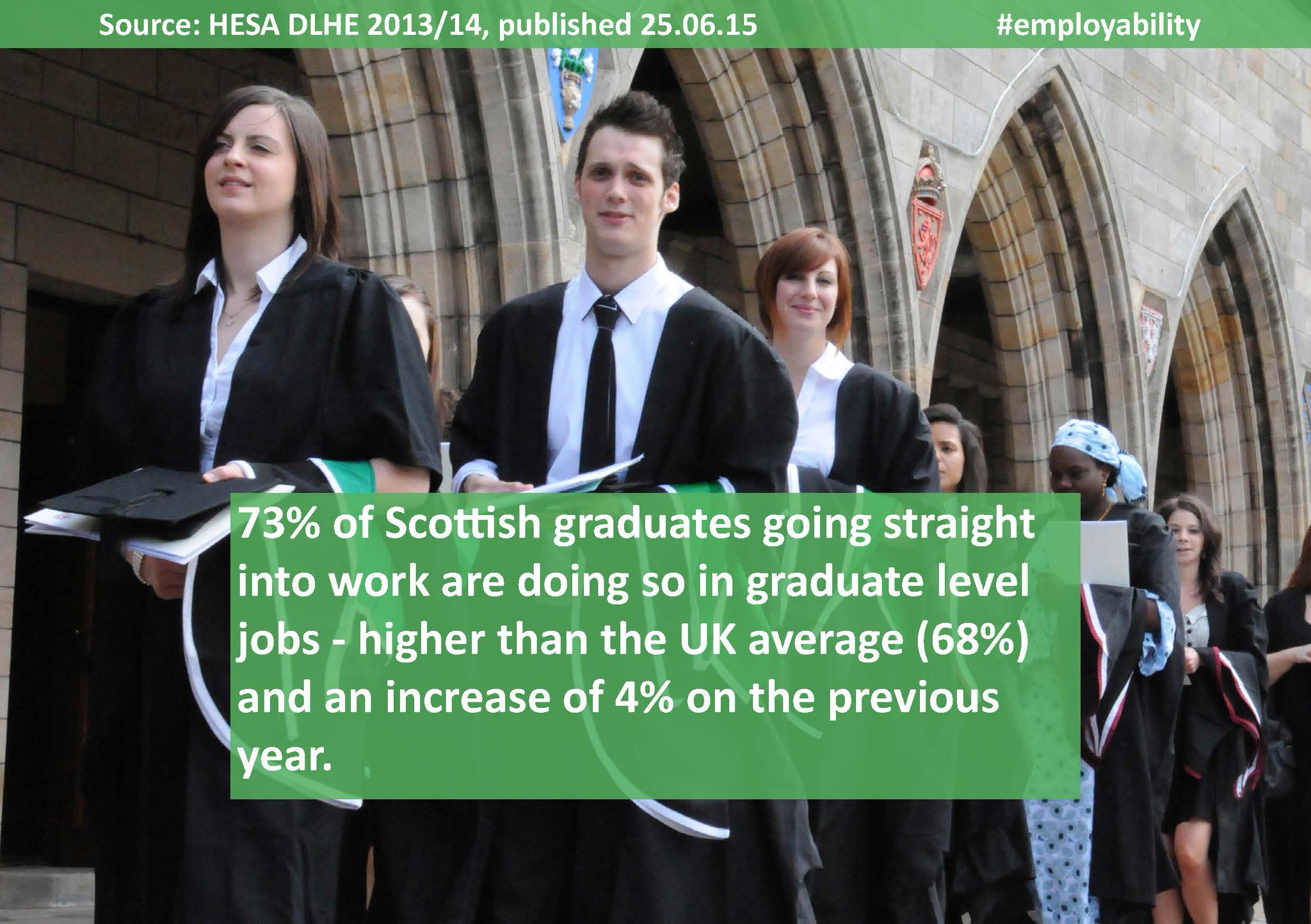
The Chartered Institute of Personnel and Development has just issued a report arguing that the UK has a particularly high proportion of graduates in non-graduate jobs and that this figure has increased over the past decade.
The annual graduate employment statistics remain much-emphasised by universities and government. Providing an alternative, more sceptical view this report is worth a bit of attention: it will be interesting to see what counter-arguments are put to this and by whom. The Guardian report notes that:
But more recent figures have pointed to an improving jobs market for graduates and the latest findings on those who left university last summer showed professional employment was up and salaries were higher. Two-thirds of graduates from full-time degrees were in posts classified as “professional employment”, according to the Higher Education Statistics Agency (Hesa).
Student grants look set to provide one the first clear illustrations of the difficulties of being in opposition in one place and in government in another.
An early day motion put down by Jeremy Corbyn on 13 July stating:
That this House notes the increase in the participation of working class students in higher education since maintenance grants were reintroduced; condemns the proposal to cut grants as a direct attack on the poorest people accessing higher education in England; further notes that the transition from a subsidy to a loan will push the poorest into the highest level of debt; and urges the Government to halt these plans in favour of a system whereby students can access more generous grants in order to cover the rising costs of living.
has been signed by three SNP MPs (Chris Law, Christopher Stevens and Michelle Thomson – though not Mhairi Black, famously the most recent graduate at Westminster). But there’s a catch.
In 2013, student grants in Scotland were cut very significantly – some 40% or £35m was removed from spending on means-tested student grant. The worst affected students lost over more than £1,500, or more than half their grant – some mid-course. As now proposed in England, the lost grant was replaced with loan. As result, Scotland became the only part of the UK where the less your family earned, the more you were expected to borrow. England will go the same way from next year, as the motion notes. The changes in England are at least being phased in for new starts only.
A motion put down in the Scottish Parliament in June 2013 seeking reversal of the grant cuts in Scotland received very unsympathetic treatment from government backbenchers. The motion, S4M-06843, moved by Hugh Henry (Lab) stated:
That the Parliament notes the introduction of the minimum income guarantee for students; notes that grants for lower-income students are being cut; believes that lower-income students are being financially disadvantaged in Scotland compared to elsewhere in the UK; does not accept that lower-income students should be disadvantaged in order to provide support for those from better-off households, and believes that the cuts to grants for lower-income students should be reversed in order to address inequality in access to higher education in Scotland.
No government backbencher signed it, those who spoke in the debate were uniformly critical of the opposition for proposing it and all votes from the government side were for a replacement which removed all criticism (indeed, mention) of the cut.
It may be significant that the SNP members signing the Westminster motion all did so in the first few days after it was put down. It is possible that the tension may have been spotted, but not quite in time to stop a few people from going with their instincts.
The grant cuts at Westminster deserve to be challenged. It’s a pity that a similar challenge in Scotland received such a different response from the SNP in government, but it would be good to think that these three MPs might now use their position in that party to challenge from within decisions made on grants in Scotland which the evidence here suggests they must believe to be wrong.
Stewart Hosie MP, the party’s deputy leader is reported to have said immediately after the budget (emphasis added):
The Tories’ cuts in the living standards of young people are particularly severe, including scrapping student grants. The SNP Government will continue to deliver grants for the poorest students in Scotland, demonstrating the benefits of having these powers in the Scottish Parliament, rather than in Tory hands at Westminster.
As with the Early Day motion discussed in this post, there’s a difficulty with this line, because student grants have been severely cut in Scotland in recent years. Total spending on grants is now about three times higher in England than in Scotland, proportionate to size. The phasing in of the changes in England means that by 2017-18 total grant spending in England will still only have fallen to something around current Scottish levels – it won’t fall below those until 2018.
Indeed, looking at the picture since 2001, when Scotland was first able to implement a different policy on grants, and 2018-19, by when the English changes have taken almost full effect, spending on grants in Scotland will often have been well below the (rough) figure of 10% of spending in England which would suggest broad comparability. On current policy, spending on grants will have been proportionately higher – since 2013-14 much higher – in England than Scotland in 10 years out of these 18.
In other words, whatever separate case may be made in relation to fees, student grant is not the best advertisement for devolution’s capacity to do more for students, particularly in the period since 2007.
Background: detailed calculations
Scotland spent relatively more on grants between 2001-02 and 2007-08 (at points double the amount relative to size), but subsequently fell behind, as grant rates were substantially increased in England, but frozen and then cut in Scotland. For the recent years for which figures are available (all figures £m):
| 2007-08 | 2008-09 | 2009-10 | 2010-11 | 2011-12 | 2012-13 | 2013-14 | |
| actual | actual | actual | actual | actual | actual | actual | |
| Scotland | 72.4 | 70.7 | 75.3 | 93.5 | 90.7 | 89.4 | 53.0 |
| England | 629.6 | 998.6 | 1207.8 | 1259.1 | 1,334.60 | 1,433.30 | 1,590 |
| Scot as % Eng | 12% | 7% | 6% | 7% | 7% | 6% | 3% |
Figures from SLC and SAAS.
… and looking ahead, on current policy spending will remain lower pro rata for some time yet. The figures here assume no major change in spending 2014-15 and 2015-16 (which saw no major policy changes on grant in either country) and take into account a small grant rise planned in Scotland from 2015-16 and the phasing out of grants for new starts only in England from 2016-17.
| 2014-15 | 2015-16 | 2016-17 | 2017-18 | 2018-19 | |
| est | est | est | est | est | |
| Scotland | 53.0 | 60.0 | 60.0 | 60.0 | 60.0 |
| England | 1,590 | 1,590 | 1113 | 715.5 | 238.5 |
| Scot as % Eng | 3% | 4% | 5% | 8% | 25% |
With the abolition of student grants announced earlier this month, in 2016 England will join Scotland in having a student funding system which expects the poorest students to borrow the most. Wales and Northern Ireland are still, for now at least, holding out for the use of student grant at a sufficient level to ensure poorer students are not expected to borrow more than their better off peers (and in the case of Wales, substantially less).
England is also coming into line with Scotland with the planned freezing of the loan threshold. This blog has repeatedly made the point that the lower loan repayment threshold in Scotland has a particualrly large effect on lower earning graduates. The new English threshold is in effect the current one for Scotland. Using IFS figures, Andrew McGettigan points out that moving to this new, lower threshold “increases the costs of undergraduate study by a quarter or more” for those in the bottom 70% of earners, compared to the original plans for a higher threshold in England – while the abolition of grants in fact has very little impact on that group, for the reason discussed below.
Two large differences remain between England and Scotland.
The first, of course, is that total debt will be even higher south of the border. That has the counter-intuitive effect that the latest grant cuts will have no real impact on the majority of poorer students: the IFS estimates that up to two-thirds of those at low incomes will see no difference in what they pay back, because they were already unlikely to pay their whole debt before it was written off (after 30 years). Those most affected will be the graduates from poorer homes who go on to earn relatively well: it’s an almost perfectly designed de facto social mobility tax. The Scottish grant cuts by contrast added debt to a lower pre-existing level borrowing (around half the English level) so they are more likely to translate into real extra payments for poorer students, across all but the lowest earners. In both cases, the policy change has increased costs at low incomes on paper: in Scotland, the total debt resulting is still lower, but the changes will have a much larger impact in practice. It’s a paradoxical effect.
The second difference is in the wildly different levels of scrutiny – and, before that, government transparency – in each case. The comparison with reaction to the changes announced in England reinforces how poorly the government policy Scotland in this area has been scrutinised and held to account, and how much freer the government in Scotland has been to avoid involving parliament or even stating outright what the effect of its decisions will be. The absence of independent voices – such as think tanks and interest groups – willing to speak up for those affected by grant cuts in Scotland is also stark, as is the lack of media coverage of domestic policy within Scotland. BBC viewers in Scotland, for example, have been informed about grant cuts which haven’t yet happened in England and won’t affect Scottish students, but not of grant cuts which have affected every student in receipt of a grant in Scotland since 2013.
The differences, and similarities, in the changes in the two countries are summarised in the table below.
[Update: it’s been pointed out that the analysis below ignores the continuing existence of grants provided direct to students by institutions in England, which now account for a substantial amount of such payments. It’s a good point. There’s not yet been any suggestion that these locally-managed payments will cease and if they do continue, then spending on all types of grant in England could in fact remain close to Scottish levels, even after the national scheme for English students is would down. However, these grants are not consistently available, making them hard to include in any comparison, and OFFA has questioned their effectiveness, so their long term future may be uncertain.]
| Scotland | England | |
| Timing | From August 2013 | From August 2016 |
| Students affected | Changes were applied to all students, including those already in system | Changes will affect new starts only, other than changes to loan repayment threshold (see below). |
| Grant
|
Means-tested grants substantially reduced, with cuts of up to 100%, depending on students’ income and whether young or mature. Overall reduction of around 40%. | Means-tested grants will be entirely abolished. |
| Maximum reduced from £2,640 to £1,750.For those below max, gradually tapered system replaced with step-change reductions, with students getting £1,000 or £500, depending on income.From 2015-16, entitlement in middle band rises to £1,125 and max entitlement rises to £1,875. | Maximum of £3,387 in 2015-16. For those below max, system is currently tapered, with entitlements falling gradually as income rises. | |
| Spending on means-tested grants fell by 40% following changes.Spending fell from £89m in 2012-13 to £53m in 2013-14. | Spending likely to fall by something like 30%/55%/85%/95% over the 4 year period from 2016-17. Spending should be de minimis by 2020.At £1.6bn, spending on grants in England is currently around three times higher than in Scotland, pro rata size. It will be at a similar level in both countries by 2017-18, before falling further in England. | |
| Thresholds | Threshold for max support was reduced from £19,300 to £16,999 (rising back to £18,999 from August 2015).Upper threshold was left unchanged at £33,999. | Threshold for maximum support will be maintained in 2016-17 at £25,000.Upper threshold for grant currently around £42,000: will no longer be relevant. Not yet clear how loan entitlements will reduce at incomes above £25,000. |
| Loan (entitlements) | Loan replaced lost grant | Loan will replace lost grant |
| Further loan was made available to increase total living cost support in real terms.Minimum loan increased from just under £1,000 to £4,500 (now £4,750). | Further loan will be made available to increase total living cost support in real terms.Minimum loan previously £3,610: no suggestion as yet that this will rise. | |
| Total value of support (grant plus loan) | Maximum support (away from home) increased by 13.6% .In 2015-16, maximum, whether living at home or away and regardless of place of study, will be £7,625.Falls to £6,875 at £19,000; £6,250 at £24,000; £4,750 at £34,000.Figures for 2016-17 not yet available. | Maximum support (away from home) increased by 13.1%.In 2016-17, maximum if living away will be £8,200. Max will be £10,702 for those in London. Living at home max will be £6,904.Applies at incomes up to £25,000. Not yet clear what figures will apply above that. |
| Debt distribution | Regressive: highest debt now expected at lowest incomes. | Regressive: highest debt will now be expected at lowest incomes. |
| Total debt | 4-year degree debt at lowest incomes of £28,000 (mature) or £24,000 (young student), including interest. | Expected 3-year degree debt of around £53,000 at lowest incomes (young and mature). |
| Loan (repayment rules) | No change was made to rules for the repayment threshold in 2013.The threshold is £17,335 in 2015-16, and will continue to rise in line with earnings.It should reach the cash value of the current threshold used in England in around five or six years. | Loan repayment threshold, currently £21,000, to be frozen for five years, rather than rising in line with average earnings as originally promised. |
| Students affected | All. | UK govt consulting on whether to apply threshold freeze only to new entrants or to all those who have taken out a loan since 2012: seems likely to be applied to all. |
| Likelihood borrowing will actually be repaid | Relatively high, due to smaller overall total and relatively low repayment threshold. | Relatively low, largely due to scale of sums involved, although freezing the repayment threshold will increase how much is repaid (by around £6,000). Freeze means that by around 2021/22, repayment threshold will no longer be lower in Scotland. |
| Form of announcement | Press release on changes to student support from 2013-14 issued 22 August 2012 making no reference to grant cuts or reduction in threshold for max support, and concentrating on increase in total combined max value of loan/grant support. No announcement of student support changes to the Scottish Parliament. SG has yet to officially acknowledge grants were reduced in 2013 (only Ministerial comment to parliament has been to suggest there had been no cuts to grants, though this was formally corrected later). | Changes to loans and grants announced to parliament in budget on 8 July, followed by a detailed ministerial written statement on 9 July. |
| Reaction | ||
| Parliament/opposition parties | Opposition debate June 2013 and various opposition PQs: criticism from Conservatives, LibDems and Labour (not Greens). No parliamentary approval required for changes. | Early day motion opposing grant cuts, with signatories so far from Labour, Lib Dems, SDLP, DUP and SNP. Greens have started a petition on 38 Degrees. Regulations will need to be approved by parliament later in year. |
| NUS | Very positive, addressing only the general increase in living cost support, telling members “Take some time today to celebrate and reflect on what a huge win this is, one that will fundamentally change the lives of so many of our members. … Today is a great day for the student movement in Scotland, so take some time to savour it.” | Very critical. |
| BBC | Has never reported grant cuts in Scotland; repeated terms of SG news release in August 2012. Did report grant increase of £125 announced in May 2015. | Various pieces on planned grants cuts and loan repayment increase. |
| Press | No reporting of grant cuts until opposition identified the plans in October 2012 (picked up by Scotsman only). More coverage since summer 2013, prompted by work by this author. | Extensive coverage of grant cuts immediately after announcement and of trails of announcement in preceding month. |
| Independent think tanks/commissions | No analysis or reaction to changes in Scotland in almost three years since they came to light. | Briefing note from IFS on impact of changes in England published on 21 July 2015.Comment on effect of grant cuts in report from Independent Commission on Fees on 30 July 2015. |
| Other | Report commissioned from this author (a freelance researcher) as part of ESRC-funded project in early 2014, after self-publishing. | Mainly so far on the Critical Education site, run by freelance research Dr Andrew McGettigan. |
Only two-thirds of the poorest young students in Scotland are benefiting from the Scottish Government’s flagship policy of a “minimum income guarantee”. Most of the rest are trying to get by on just £1,750 a year in grant.
My evidence to the Commission on Widening Access (in full here) highlights this as a critical issue for the Commission to consider. In particular, the Commission is asked to take a view on whether the the Scottish Government has acted responsibly in shifting support for poorer students ever more heavily into the form of loan, while still trying to benefit politically from a negative rhetoric about the impact of borrowing on poorer students.
In 2013, Scotland moved to a system of funding students’ upfront living costs much more heavily reliant on loan than before, cutting grants and using additional loan to generate an real-terms increase in total support. It did so even though in a report to the Scottish Parliament in April of that year the Scottish Government argued that (emphasis added):
… evidence sources suggest that the fear of debt and cost of study can potentially dissuade prospective students to going to university. People from disadvantaged family backgrounds are especially vulnerable in this respect.
BIS research notes that most young people see debt as a normal part of life, but that those with the most negative attitudes to debt are among those least likely to apply to HE. It suggests that students from low income households see the costs of HE as a debt rather than an investment. Those from less privileged backgrounds were more likely to be concerned about debt, and those most averse to debt were among the less willing to participate in HE …
So it should not be a great surprise to learn that if low income students are offered support which looks like this (2014-15 figures):
| Household income | Bursary | Loan | Total | % as loan | Implied 4 yr debt |
| £0 to £16,999 (young) | £1,750 | £5,750 | £7,500 | 77% | £23,000 |
| £0 to £16,999 (mature) | £750 | £6,750 | £7,500 | 90% | £27,000 |
.. against a government rhetoric about the unattractiveness of student loans which sounds like this ….
As somebody who had a modest upbringing in a council scheme in Linlithgow, whose parents in an atmosphere of both free education and full grant, scrimped and saved to send four children to university, I know what a challenge and what would have happened with the imposition of large debt to people like myself. (see here)
I would not have had that opportunity [to go to university] if there had been a policy of tuition fees in place, because even if there had been a policy of paying them back later, the prospect of accumulating that scale of debt would have been enough, I think, to lead me not to go to university. (see here)
… many students entitled to a maximum bursary appear to find the level of borrowing needed to obtain the “minimum income guarantee” unattractive.
Here are the figures in detail, obtained not from any analysis published by the government, but from further questions (they are for 2013-14, the only year under the new rules for which there are figures):
| Actual on full grant | Actual on maximum living cost support | % take up of maximum living cost support | |
| YSB claimants | 17,330 | 11,485 | 66% |
| ISB claimants | 17,340 | 13,645 | 79% |
| Total | 34,670 | 25,130 | 72% |
We can also tell that most of those on a grant who didn’t borrow the maximum, borrowed nothing at all – there are very few “partial borrowers”:
| YSB | % of all YSB takers | ISB | % of allISB takers | Total | % all YSB/ISB takers | |
| Taking no loan | 8,090 | 25 | 2,620 | 15 | 10,710 | 21 |
| Taking part of loan | 1,775 | 5 | 300 | 2 | 2,075 | 4 |
| Taking whole loan | 23,065 | 70 | 14,480 | 83 | 37,545 | 75 |
| Total | 32930 | 100 | 17,400 | 100 | 50,330 | 100 |
The unavoidable conclusion from these figures is that many students at the lowest incomes did not just reject the full “minimum income guarantee”, they limited their entire state support to an amount of grant that would barely cover their commuting costs, even if they tried to save money by living at home (in a household where money is by definition already tight).
The Scottish Government urgently needs to review a policy that evidently isn’t working for many of those it most needs to help. At the very minimum, it needs to stop making political capital by talking down student loans, while shovelling these towards poorer students in large amounts, as their only alternative to derisory levels of state support. At the moment, the “minimum income guarantee” is a policy which is failing many of those it is intended to help and something – the heavy reliance on loan, or the surrounding negative rhetoric about student borrowing, or probably both – needs to change.
Critics of government policy on student funding in Scotland have had no success in getting a hearing over the past two years. The government’s dismissal of figures just last week showing Scottish students making more contact with payday lenders than those from elsewhere in the UK, revealed more of the same Jekyll-and-Hyde attitude to loans – talking up its “minimum income” while invoking scary five-figure debt figures from south of the border.
Perhaps Ministers might listen to the Commission on Widening Access if it takes an interest in the situation described above. Let’s hope it will.
My evidence to the Access Commission concentrates on the relationship between student funding and widening access. It’s provided in full below, under the three headings the Commission has asked those responding to its call for evidence to use.
(More detailed evidence underpinning the points made is provided here: Annex to Access Commission evidence.)
The identification and removal of barriers to access and retention
The available evidence suggests that student funding plays a smaller part in determining participation in higher education by disadvantaged young people than is generally asserted in political, media and social discourse. Other factors, such as family attitudes, school attainment and subject choice and the extent of well-designed access work undertaken in schools, appear likely to have a much larger influence.
Elements of student funding which have been argued at various times to have an effect on participation are:
- Tuition fees: International and internal UK comparisons provide no evidence for a link between fee levels and access, particularly once the immediate costs of fees are covered by access to a state-supported loan.
- Total debt (whether for fees or living costs): Contrary to expectation, across the UK as debt has increased so has participation by young people from disadvantaged backgrounds. This does not rule out that some young students are deterred by debt and various studies emphasise the need to understand better which students are most debt averse. However, in general terms any deterrent effect is being outweighed by other factors. Participation by mature students, whose numbers are falling in all parts of the UK, seems to be more sensitive to debt: but even for this group, other factors also seem likely to be having an effect.
- Grant rather than loan: There is some recent research evidence that substituting grant for loan in living cost support may slightly increase participation by low-income students, which would be consistent with some in this group being relatively debt-averse.
- Total support for living costs: Again, there is some evidence that increasing living cost support in total, whether using grant or loan, slightly increases participation, which would be consistent with students from low incomes being otherwise deterred by an inability to meet upfront costs such as rent, food etc .
Issues for Scotland
(i) Largely loan-based living cost support
In Scotland, the system for supporting living costs is heavily dependent on the use of loans: at low incomes, students must borrow between £6,750 and £5,750 a year in order to obtain their full support, implying a total debt of between £23,000 and £27,000 over four years (more for those on 2+3 models). This model is not working for many of those for whom the most help is intended. Only two-thirds of the poorest young students borrow enough to obtain the government’s “minimum income guarantee”: most of the rest rely entirely on very limited amounts of grant (below £2,000 a year).
It is not clear how far non-borrowing students do not need all the help on offer, despite their very low declared family income, and how far they are not willing to use the student loan system, even if this causes severe hardship or makes participation unaffordable. As far as it is the latter, Scotland’s large reliance on living cost loans will be having some effect on widening participation, not least among those groups least able to live at home (including many from rural areas and those from troubled or poorly-housed families). The Commission should consider whether some improvement in grant is needed to address this.
(ii) Information about loans
Debt aversion may be an absolutely unavoidable in some students. However, it is possible that the relatively large numbers of non-borrowing low-income students is partly a function of the poor quality of public debate and education about student loans in Scotland. The Scottish Government has greatly increased its reliance on student loans (now exceeding £0.5bn a year) while maintaining a rhetoric which discourages students from seeing these as a safe way of funding their higher education. For example, speaking on his last day in office, the previous First Minister said:
As somebody who had a modest upbringing in a council scheme in Linlithgow, whose parents in an atmosphere of both free education and full grant, scrimped and saved to send four children to university, I know what a challenge and what would have happened with the imposition of large debt to people like myself.
This contradiction between policy and rhetoric is unhelpful and those most likely to be damaged by it are those from low-income backgrounds who are deterred from entering higher education because they are fearful of taking out a student loan or who attempt to rely entirely on grant to fund their studies, when they cannot rely on family support in cash or kind. Assuming that the government has no plans to reduce its reliance on student loans, the Commission should address this point.
(iii) Living cost support away from home
Living cost support for Scottish students living away from home is relatively low compared to the rest of the mainland UK for students at incomes between £17,000 (£19,000 from this autumn) and £45,000. This would empirically be expected to be having some impact on participation, again particularly among those less able to live at home. It may also be limiting the HE choices of lower-income students. A family income in the £20,000’s remains relatively low. The Commission should consider whether the support for students living away from home is adequate at incomes just above the threshold qualifying students for maximum support.
(iv) Investment choices
In 2013-14, every £1,000 per head of fee funding for students in the top half of the income distribution cost the same to the cash budget as the government’s entire spending on grants (£65m in each case). That figure may also be compared with the £25m per year (£100m over 4 years) recently announced by the Scottish Government for the “Scottish Attainment Challenge” fund. The Commission may also wish to examine how £65m compares with the total spending on access-related initiatives, if it has access to that information.
Given how budgeting works within government, it is very hard to believe that the political priority given to saving higher income students from incurring any debt at all for their fees has not had a knock-on effect on the funding available for more targeted investment in the education and support of young people from disadvantaged backgrounds.
The Commission’s remit appears to take universal free tuition as a given: however, it would do a great service to the access debate in Scotland if the Commission were at least to make a clear statement on whether it believes the present model of universal 100% cash funding for tuition in Scotland plays an active part in promoting wider access (and if so, by what mechanism and on what evidence it bases that conclusion). Given the sums at stake, and the limited availability of cash resources to the Scottish Government, the Commission should also assess the relative benefit in terms of widening access of cash funding the whole fee cost for all students compared to spending elsewhere in the education system.
(v) Long-term equity
My research concentrates on the distribution of debt amongst students. In Scotland, the arrangements for student funding are unique in the UK in assuming the highest levels of student debt amongst the poorest students. This pattern is also reflected in actual borrowing, again uniquely in Scotland. Low-income students are more likely to borrow than those at higher incomes and on average will borrow more.
The Scottish Government tends to respond to any criticism of debt distribution in Scotland by quoting the Student Loans Company’s figures for final average borrowing across the UK. These figures are misleading, concealing that since 2013 low-income degree students in Scotland face much the same level of debt as their counterparts in the other devolved administrations, and in some cases more, while students from higher incomes in Scotland have the lowest debt of any group in the UK and in many cases are still able to leave university with no debt at all.
The Scottish arrangements are building up a regressive sharing of student debt in the Scottish graduate population. Those who started with least will end up owing the government most. This has implications for social justice in the long-term and the embedding of inequality over the generations. Those least able to rely on family help through immediate support or inheritance are those who will also have to forego the most from their salaries in future, reducing their relative capacity to pay for housing, pensions, childcare or other costs. This is simply unfair. It is not a widening access issue as such. But it raises the question of whether the cost of widening access is expected to be covered disproportionately by deductions from the future earnings of those from poorer backgrounds. The Commission should consider this point.
The identification and scaling up of best practice
Research undertaken in England suggests that locally-provided additional institutional bursaries are not especially effective in supporting wider access: see An interim report: Do bursaries have an effect on retention rates (OFFA publication 2014/02) and Have bursaries influenced choices between universities? (OFFA publication 2010/06). OFFA is currently undertaking further research in this area, following the changes introduced in 2012.
More generally, OFFA has invested in considerable amounts of research into widening access good practice, which the Commission should systematically review.
The data and measures needed to support access and retention
The figures collected by SAAS on the take up of student support should be used much more to monitor changes in the student population and student behaviour, particularly at low incomes. The SAAS data is particularly useful because by definition it covers all those students benefitting from government support in HE, whether at university or college.
The figures currently published do not:
- distinguish between the poorest and the most well-off students in the income-related table;
- provide data on the take up of the “minimum income guarantee” – figures on this have had to be obtained through further questions;
- more generally, provide data on the take-up of grants, fees and loans, and total living costs support, by different levels of grant entitlement.
Also, more use could be made of systematic analysis of changing trends in grant take-up. For example, the total number of students on income-related grants fell between 2012-13 and 2014-15 by 1.9%, from 51,515 to 50,560. It would be useful to see this trend analysed and explained.
The Commission should consider how more use could be made of SAAS data by government and how more information could be published as standard.
Other comments
The timing and relatively short period for this evidence gathering exercise is likely to mean that many people with a useful perspective will have been unaware of it or unable to respond in time. It is welcome that the Commission has taken steps to ensure that its interim report can be informed by evidence from this exercise. However, to be sure of tapping existing expertise properly, it would be good if the Commission were to undertake a further evidence gathering exercise on a longer timetable which did not overlap with the school holidays.
Last month the Cabinet Secretary for Education announced an increase in bursaries of £125, for all students with incomes below £24,000.
The SAAS website has now been updated to reflect this – but here’s an odd thing. It says (emphasis added):
The amount of bursary you can get will depend on the household income in your permanent home.
Bursary and loan details Household income Bursary Loan Total £0 to £16,999* £1,875 £5,750 £7,625 £17,000 to £23,999* £1,125 £5,750 £6,875 £24,000 to £33,999 £500 £5,750 £6,250 £34,000 and above £0 £4,750 £4,750 * This includes a one off payment of £125 which will be available to these students in early 2016.
So this is not a conventional grant increase. Instead, in January the students affected will get a “one-off” extra payment. I don’t think there’s ever been anything quite like this done in the grant system. Usually any grant increase is simply built in from the start of the year.
Why the government is going to the extra trouble (and potential confusion for students) of a stand alone payment is unclear. Specifically, when it is described as a one-off, does this mean this is just a payment being made this year, but might not be repeated? That might explain why SAAS is not going to the trouble of updating its basic systems. But in fact that can’t be it – last month’s press notice says (emphasis added):
Thousands of students from the poorest backgrounds are to receive more financial support over the coming years under plans announced by the Scottish Government.
Bursaries for higher education students from Scottish households with an income of up to £24,000 will increase by £125 from academic year 2015/16.
Maybe it’s still come too late to be programmed into the system safely.
And why wait till “early 2016” and not give it to students sooner, when it might come in handy, particularly for the 28% of students who only claim their grant and decline any loan, most of whom almost certainly live at home and who might find it useful to help pay for an annual season ticket or a new student railcard (£120)? The only good defence for the delay would be that this is the absolute soonest SAAS can bolt this on.
The late announcement of this extra amount was already pushing the boundaries of conventional behaviour round student grant. This aspect of the handling adds a whole new twist.
 Adventures In Evidence